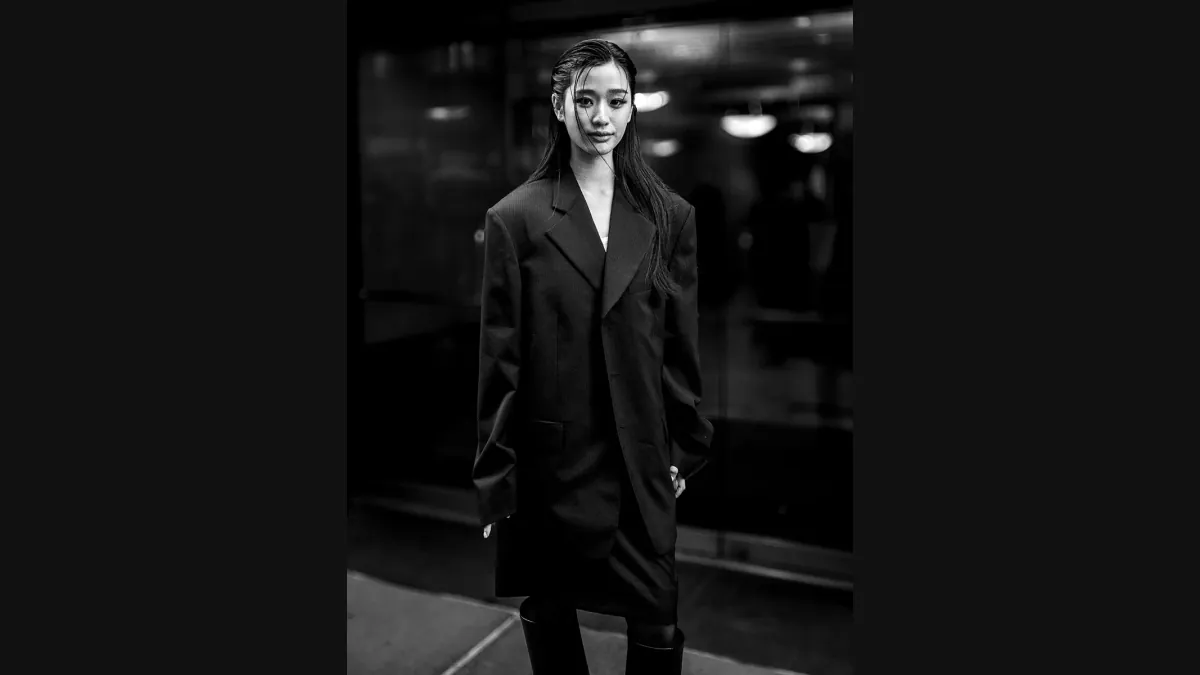
The coat has broad lapels and a dark, almost uninterrupted line. A few strands of hair cross it. Behind the figure, street highlights soften into small pale shapes. In Phoebe Locke’s featured photograph, those relationships give a passing encounter the concentration of a portrait.
Locke made the independent photographs outside Calvin Klein’s Fall 2025 show. In Jessica Miller’s September 5 interview for Amateur Photographer , she recalls finding the New York show and photographing models and guests as they left. A campaign for the house is an ambition she describes for the future.
That gives the pictures a clear context and leaves room to look at her own decisions. The house’s name identifies the occasion. The position, timing and treatment of the figure tell a prospective collaborator something about the photographer. Both belong in the presentation, doing different work.
In the black-and-white frame, the lapels guide attention toward the face while the arms leave space around the coat. Its shape stays legible against the softer background. The face is the brightest concentrated area, with smaller lights scattered behind it. Clothing and expression hold together without needing a busy surface or an elaborate setting.
Give a collaborator something specific to recognize
A portfolio gives those decisions a chance to recur. Perhaps a photographer keeps finding a clear silhouette in busy surroundings. Perhaps a pause in a gesture appears across otherwise different subjects. Seeing that relationship more than once helps a viewer recognize an approach they could discuss for another project.
An encounter outside a show can make the decisions visible in a short time. People move, distances change and the available light keeps the setting in play. A brief exchange leaves the photographer choosing where to stand and when the figure has enough space. The resulting frame can carry an intention beyond the event around it.
A concise caption can establish that this was independent work around the show. Then the edit can concentrate on what the photographer noticed. Accurate context gives the pictures a firm footing, while a small selection lets each visual decision receive some attention.
Imagine showing the same photographs in two sequences. One follows the best-known names in the captions. Another follows a repeated gesture or a changing relationship between body and coat. The second gives the next collaborator a specific possibility to discuss: could that treatment work with another wardrobe, person or place?
Let the next frame change the view
Fashion photography connects clothing with bodies, places and characters. A sequence can move among those relationships. The change in scale from a street scene to a sleeve detail can make the garment feel present in a setting, then bring the viewer close enough to read its surface.
An opening frame might show the environment. A closer one could pick up a collar or expression. Another may introduce movement. Choose the shifts the actual pictures can support. A quiet series can stay quiet, and a strong repeated viewpoint may need less variety than an unfamiliar editorial formula suggests.
Lay the edit out where you can see it together. Two portraits may each be good while doing nearly the same job in the sequence. Removing one can give the other more room. A wider frame might reveal where the gesture began, while a detail can echo the angle of a lapel seen earlier.
Read that edit once with the brand references out of view. Can you still follow the mood, the shapes and the changes of emphasis? Restore the captions and credits afterward. The visual relationships should have something to say, with the supporting text giving them an accurate history.
Make room for the people around the photograph
Locke tells Amateur Photographer that storytelling and creative direction interest her. In a planned production, those interests connect to decisions made before exposure: casting, wardrobe, location, hair, makeup, lighting and performance. Each changes what the photographer has in front of the lens.
Credits let another team see those contributions. Naming the stylist or creative director makes collaboration legible. When the photographer also develops the concept or styles self-directed work, a short project description can establish those roles without suggesting that every part was made alone.
In my collaboration guide at Kisau Photography , the concept connects decisions about wardrobe, setting, light, and movement. We agree responsibilities and image use before the session, then bring the participants' perspectives into the final selection. That shared preparation gives a team a common direction while leaving space for a spontaneous gesture.
The Kisau shopping-bag editorial offers another example from my work: one oversized prop becomes a recurring element across a sequence. The practical question is how each frame develops the idea rather than simply repeating the object.
Follow one visible quality into the next project
The featured portrait suggests one possible brief through its relationship between clothing and gesture. Another photographer’s edit may point toward movement, color or a way of using distance. Name the quality that holds your strongest frames together, then give the next small project a setting in which it can develop.
A sentence about the intended atmosphere can be enough to begin. Add a few decisions the team can act on: the room around a body, the response of a fabric or the moment of a turn. Afterward, compare the edit with that intention. An unexpected frame may suggest another direction worth following.
The loose hair in Locke’s portrait crosses a coat with a very controlled outline. That small interruption keeps a formal shape connected to a person in the street. It is the kind of decision a collaborator can point to, remember and carry into a conversation about what to make next.