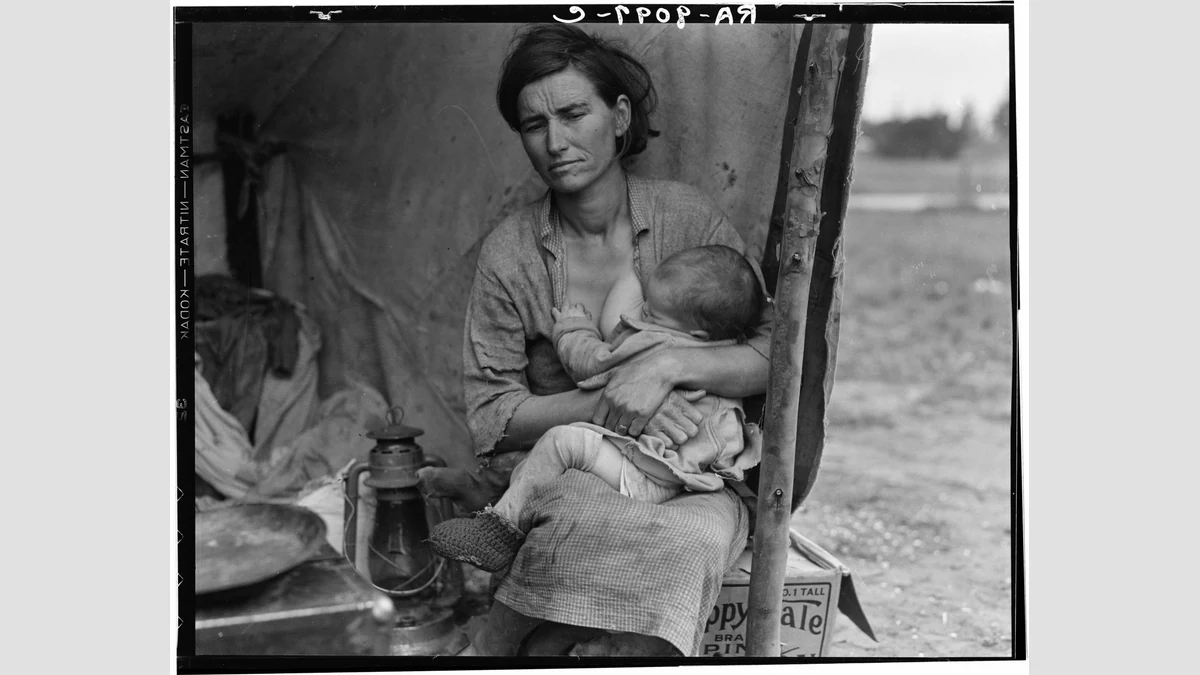
A new Fstoppers account of “Migrant Mother” returns to the woman inside Dorothea Lange 's famous photograph, Florence Owens Thompson. The Library of Congress holds more than the familiar close portrait. Its wider frames offer a practical lesson for photographers and readers: a photograph can be truthful about what it shows while leaving much of a person's life outside the frame.
Start with the wider negative
The Library of Congress record for an earlier frame shows Thompson seated with a child in her arms at the opening of a tent. A lantern, bedding, the tent pole, and open ground remain visible. The photograph still directs attention to her expression, but it also shows a place and an immediate domestic task. In the best-known “Migrant Mother” portrait , the frame is tighter. Children turn their faces away, leaving Thompson's face and hand to carry much of the picture's emotional weight.
This is not evidence that one exposure is honest and the other false. It shows how sequence and selection change a reader's interpretation. The wider negative gives more context without explaining every fact about the family. The close portrait is extraordinarily legible as an image of worry, which helped it travel far beyond the camp. Neither photograph can supply Thompson's own account on its own.
The Library's research guide to the series makes it possible to read the pictures together rather than treating the famous frame as the only record. It also preserves Lange's account of the encounter. That account is valuable evidence of the photographer's method, but it is one person's recollection. A caption and a photographer's memory should be checked against the subject's history whenever that history becomes part of the story.
Restore the subject's name and agency
Thompson's name was absent from the original image's public life. Fstoppers recounts how she later objected to being reduced to a symbol of defeat. A Library of Congress account records her daughter's description of Thompson as a strong woman and a leader, and explains why the family disliked a picture that did not reflect that side of her. These later voices do not erase the hardship visible in the 1936 photographs. They widen the account of who she was.
The archival captions also need care. Some details attached to the series came from Lange's field notes, while Thompson's family later disputed parts of the familiar story. The photographed scene is evidence that Thompson and her children were there. It is not independent proof of every statement later attached to the image. Readers can appreciate the photograph's force while separating what the negative shows, what the caption says, and what the family subsequently said.
A useful practice for today's photographers
When a portrait begins to stand for a larger cause, keep the rest of the contact sheet and the subject's name close to the published frame. Record what the subject said, what the photographer observed, and what a caption infers. If a later account changes those details, correct the caption without treating the image itself as the entire biography.
That discipline applies well beyond an archival icon. A compelling composition can invite a viewer to finish a story the frame has not actually told. Lange's sequence remains powerful precisely because we can look again, compare the frames, and let Thompson be more than the single expression that made one photograph famous.
What the archive can and cannot settle
The Library of Congress records give the series a durable address, a credited photographer, and scans made from negatives and prints. They allow readers to compare specific frames rather than relying on a memory of the famous one. They do not, by themselves, settle every later account of the encounter. In particular, an official catalog caption may preserve what was recorded in the field, including a claim that subsequent family testimony contests. An archive keeps evidence available. It does not turn every old annotation into an uncontested fact.
That is why the wider photograph is a useful starting point but not a replacement icon. Its lantern and tent opening tell us more about the surroundings. Thompson's care for the child in her arms is visible. The frame still does not tell us what she thought of Lange, what work her family had done before that day, or how she wanted to be represented. Those questions require voices and records beyond the negative. A photographer who publishes a portrait as social evidence has a responsibility to keep those distinctions legible in the caption.
Fstoppers' fresh historical account is strongest when it restores Thompson's story to a picture often discussed mainly as a masterwork of composition. The Library's series supplies a second, visual line of inquiry. Read together, they invite a more precise description: Lange photographed a real family facing hardship, selected a frame that became nationally recognizable, and left the subject's fuller identity outside the image that circulated most widely. None of those statements requires treating the picture as staged or the subject as merely passive.
For a contemporary editor, the practical habit is simple. Preserve a sequence, verify names, date and place, separate observation from inference, and revisit a caption when the subject or family supplies a credible correction. The closest crop may be the most memorable, but the reporting around it determines whether a reader meets a person or only a symbol.