The redesign is really about framing
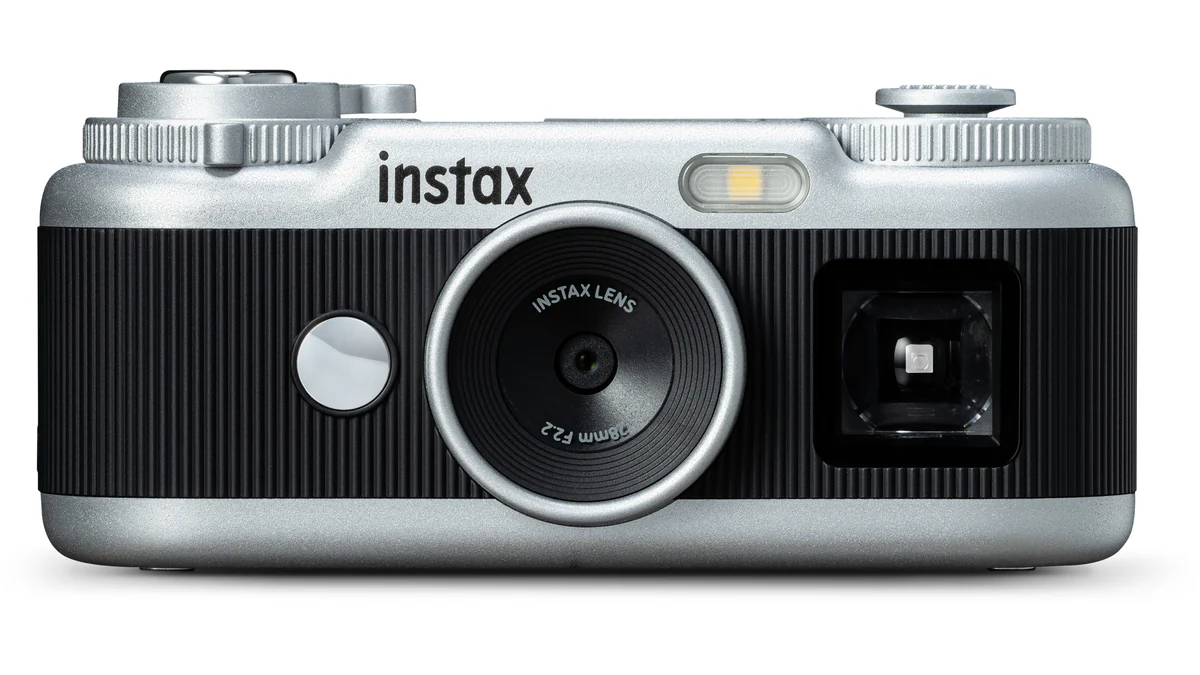
Fujifilm has rebuilt the Instax Pal around a familiar photographic act: deciding what belongs inside the frame. The company’s official Instax Pal 2 announcement says the new camera adds an optical viewfinder, a top-mounted monitor, a control dial, and a lever to the palm-size concept introduced by the original Pal.
That change is more significant than the retro styling suggests. The first Pal deliberately stripped capture down to a shutter button and relied heavily on its companion app. The Pal 2 puts visual feedback and tactile choices on the camera itself. It still fits into a connected Instax workflow, but it now behaves more like an object used to compose a photograph than a remote sensor waiting to hand the image elsewhere.
The optical viewfinder and top monitor offer two different kinds of attention. The optical window encourages eye-level, approximate framing. Digital Camera World’s hands-on Instax Pal 2 first impression describes the one-inch screen as a waist-level finder as well as a place to review pictures. On a 41-gram camera, those are not just decorative references. They change posture, timing, and how conspicuous the act of taking a picture feels.
Ten megapixels make the promise clearer, not larger
Fujifilm has doubled the recorded resolution from 5 megapixels to 10 megapixels and specifies a 1/3.06-inch sensor. Internal capacity also rises from 50 to 100 pictures, with a microSD slot available for expansion. Those improvements make the Pal 2 easier to understand as a self-contained digital camera, but they do not turn it into a substitute for a current phone or a larger compact.
The firsthand Digital Camera World report places the output above the novelty-focused Kodak Charmera but behind the Camp Snap CS-Pro, and says the Pal 2 is not expected to beat a smartphone for image quality. That is one evaluator’s early comparison, not a laboratory verdict. It does clarify the likely creative proposition: modest files, immediate decisions, and a deliberately lo-fi finish rather than maximum technical quality.
The same report notes shutter lag that can make precise timing difficult. That limitation matters because the Pal 2’s new controls invite a more deliberate shooting style. If the camera encourages photographers to frame carefully but responds late, the charm of the process may collide with missed expressions and gestures. Newsroom has not tested the camera, so responsiveness and consistency remain open questions rather than conclusions.
Black and white bodies, but no film inside
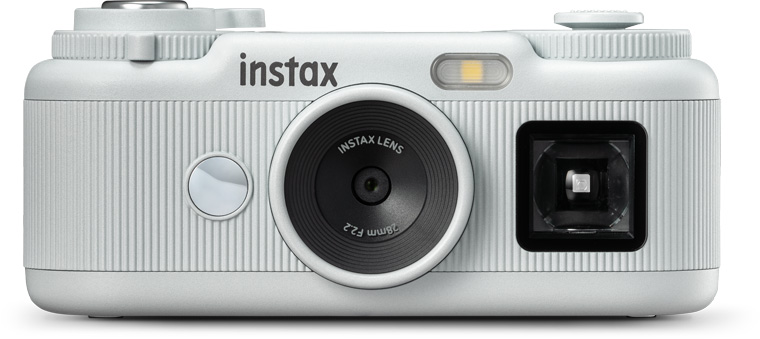
The Pal 2 comes in black and white, with a silver face, knurled surfaces, a prominent shutter release, and controls that borrow the visual language of small film cameras. It does not contain an instant-film printer. Images remain digital until they are transferred to the Instax Pal app or sent to compatible Instax Link printers and selected Instax Evo or LiPlay hybrid cameras.
That separation is the product’s defining tension. Instax is associated with a finished physical photograph appearing soon after exposure. Pal 2 moves the print mechanism out of the camera, which makes the camera smaller but turns instant photography into a system rather than a single device. The reward is flexibility. The cost is that making a print requires additional hardware.
The camera can compose for Mini, Square, Wide, or frameless output. Those options are not interchangeable decorations. A 3:4 Mini frame, a square, and a 16:9 Wide frame organize subjects differently. Choosing the intended output before pressing the shutter is one of the Pal 2’s more credible links to an analog process because the frame affects the photograph at capture time.
PetaPixel’s independent Instax Pal 2 launch report confirms that the camera can transfer files through Bluetooth, work with the app as a remote, and send images toward the Instax printing ecosystem. The article also reports a United States price of $169.95, with availability later in September. Fujifilm lists an October 9 release in Japan, so timing and price should be checked by region.
Effects move from the app into the hand
Fujifilm provides 30 effects across Modern, Y2K, Vintage, Chromatic, and Fantasy themes. Six can be loaded onto the camera at once and selected with the control dial. The language resembles changing film stocks, but these are digital looks. Treating them as capture constraints is more interesting than treating them as a menu to browse after every frame.
The lever also switches framing choices and activates Instax Animation mode. Holding the shutter can combine up to 10 consecutive images into a flipbook-style video. A QR code can be printed with the result so the animation can be replayed on a phone. This is less a conventional burst mode than a small sequence-making tool, and it fits the Pal 2’s emphasis on playful output over peak still-image performance.
Wired transfer is unusually direct. After Bluetooth pairing, the camera’s USB-C connector can plug into a compatible phone, with Fujifilm claiming transfers as fast as about 0.7 seconds per image under suitable conditions. Bluetooth transfer remains available. The physical connector reduces one layer of friction, although real speed and phone compatibility need independent testing.
The Pal 2 succeeds if its limits become part of the rhythm
The strongest case for Pal 2 is not nostalgia alone. It is a compact workflow with enough friction to make capture feel intentional, but not so much that pictures stay trapped on the device. The viewfinders, fixed 38mm-equivalent f/2.2 lens, format choice, six loaded effects, and separate print step all narrow the decision space.
That can be creatively useful. A photographer could select one effect, one output frame, and a short walk, then avoid reviewing every picture until the end. The top monitor makes immediate review possible, but discipline does not require using it after every exposure. The camera’s value will depend on whether its shutter response, battery, app connection, and transfers stay out of the way often enough for those constraints to feel playful.
Newsroom’s earlier analysis of film-inspired digital photography separated the visual look of film from the ritual and physical object. Pal 2 combines all three imperfectly. It offers digital effects, analog-style controls, and access to an optional print, but each part can exist without the others.
Kisau Photography’s guide to camera brands that changed photography places Fujifilm’s appeal in the way film-era feeling enters digital practice. Pal 2 turns that broad idea into a very small proposition. It is not the most capable camera a person is likely to carry. It may be the camera that makes taking an ordinary picture feel different enough to be worth doing.
FAQ
Does the Fujifilm Instax Pal 2 print photos itself?
No. The Pal 2 is a digital capture camera without a built-in printer. Pictures can be transferred to the Instax Pal app or printed through compatible Instax Link printers and selected Instax Evo or LiPlay hybrid cameras.
Can the top monitor be used for framing?
Fujifilm describes the monitor as a way to review captured images. Digital Camera World’s hands-on report also describes it as a one-inch waist-level finder. How easy it is to compose on that small display remains a question for fuller testing.
When will the Instax Pal 2 be available?
PetaPixel reports availability later in September 2026 in the United States at $169.95. Fujifilm lists October 9, 2026 for Japan with open pricing. Other regions have their own dates and prices, so buyers should check Fujifilm’s local information.