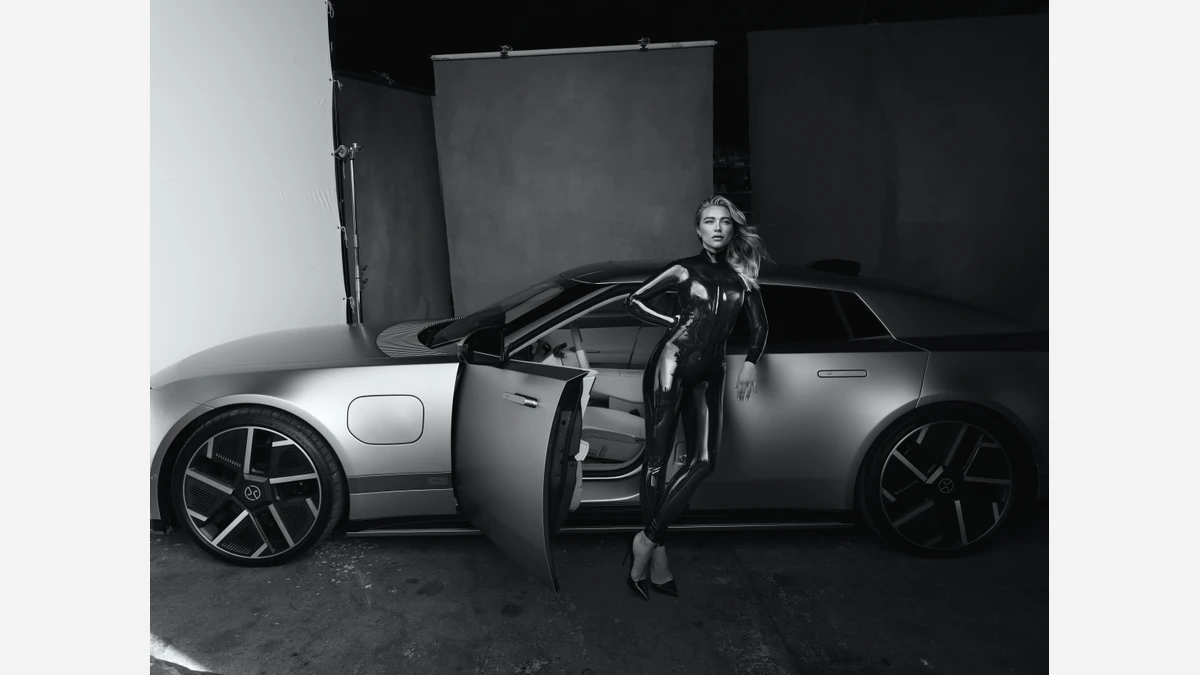
The studio backdrop stops before the photograph does. Its supports remain visible above Florence Pugh, who stands beside an open car door in a black outfit glossy enough to compete with the bodywork. The machinery of making an image is allowed into the image. Somewhere, a seamless-background salesperson is having a difficult afternoon.
This is one of Annie Leibovitz’s portraits for Jaguar’s Type 01 campaign. Tom May’s November 18 report in Digital Camera World brings a photographer’s attention to the commission. Jaguar’s November 5 announcement supplies the campaign, collaborators and official images.
The interesting photographic problem is easy to recognize. Put a famous actor beside an expensive car and either can become an accessory. Leibovitz gives their relationship something to do.
The open door earns its place
In the studio portrait, Pugh stands at the opening rather than obediently beside the bonnet. Her hand meets the upper door frame, her body crosses the car’s long horizontal shape, and the door projects toward the camera. Those three directions keep the picture from becoming a lineup of desirable objects.
The car is large enough to establish its proportions. Pugh is placed far enough from the edge to hold attention without blocking its whole identity. Her dark clothing connects with the windows, while the lighter bodywork separates her outline. Remove either subject and the composition loses a partner.
That makes the door more than evidence that the car has doors, always reassuring in this price bracket. It creates an intermediate space: someone has arrived, or is about to leave. The photograph offers a scene without requiring a plot summary.
Look above that arrangement and the hanging gray backdrop introduces another layer. The portrait admits its own construction. For photographers, that is a useful permission slip to ask whether every stand, edge and floor mark really needs to disappear. A visible studio can give a carefully controlled picture an atmosphere of work in progress.
Inside, the car becomes a frame
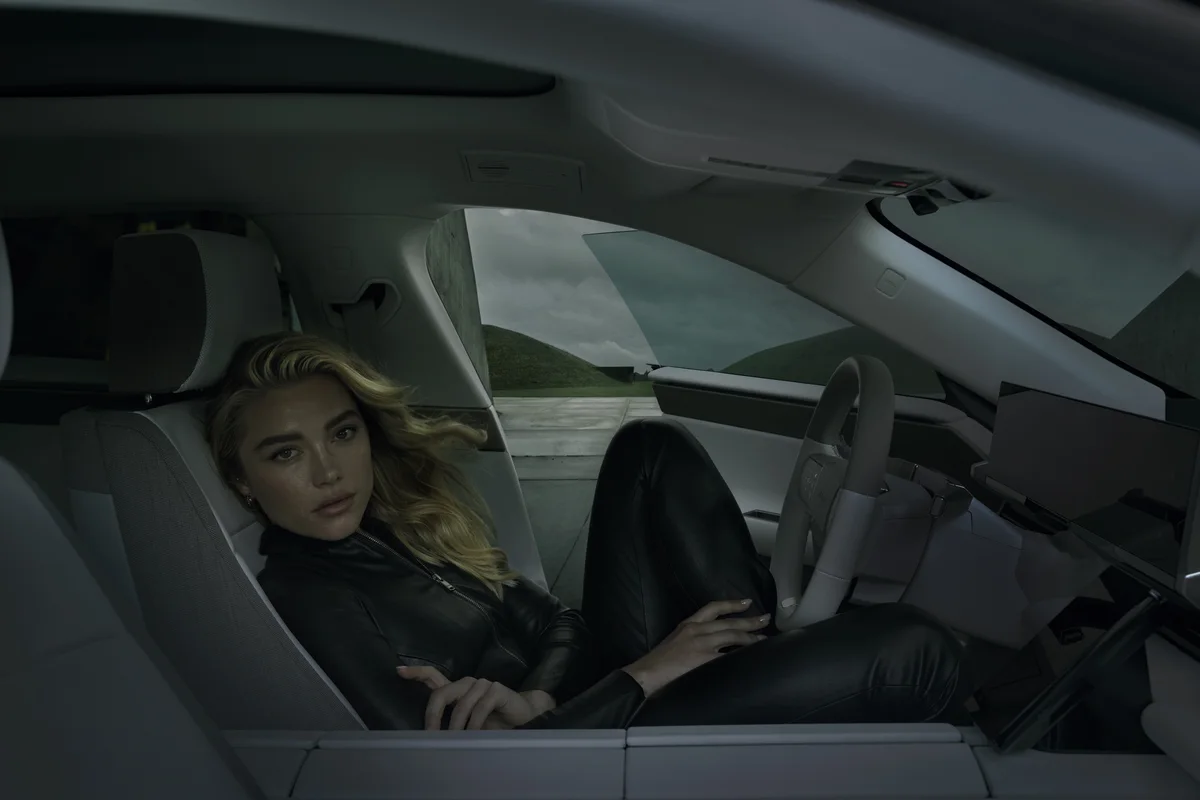
A second official portrait moves into the pale cabin. Pugh reclines across the front seat, one knee raised, looking toward the camera. The window opening and sloping frame organize the view around her. The first picture establishes a meeting between two subjects. This one lets the vehicle become the architecture of a portrait.
Her pose occupies the interior rather than merely demonstrating it. The pale upholstery, dark clothing and diagonal edges do much of the compositional work. There is enough information to recognize a designed space, without asking the viewer to inspect every switch.
These are observations about the finished pictures, not a claim to know the photographer’s exposure settings or the car’s driving behavior. The images sell a relationship with an object. A road test would have a different job.
The broader portrait question is how surroundings change a person’s presence. Environmental portraiture usually places someone in their own environment. This commissioned studio scene constructs one around an actor instead. In both cases, the setting can carry meaning rather than fill spare pixels. Newsroom’s look at Juergen Teller’s Givenchy Winter 2026 portraits approaches that question through the amount of ground left around a subject.
Two histories enter the frame
Jaguar describes Pugh as the inaugural ambassador for its new era. Its official Type 01 page is the place to follow the vehicle itself. For the actor, Florence Pugh’s official Instagram profile provides a verified public destination.
The campaign credits Rebecca Corbin-Murray for styling, Shon Ju for hair and Alex Babsky for makeup. Their presence in the credits helps explain why the apparent ease is a production achievement. Clothing, silhouette and grooming have to work with the car’s surfaces and the photographer’s framing.
For a closer look at how Leibovitz thinks through assignments, Annie Leibovitz at Work on Amazon is the revised and updated, 268-page hardcover matched to Phaidon’s edition , ISBN 9781838668204. It offers process and career context. Published in 2024, it predates this campaign.
The other history belongs to the badge. Nigel Thorley’s The Complete Book of Jaguar: Every Model Since 1935, Second Edition on Amazon matches Motorbooks’ 272-page 2026 edition , ISBN 9780760397619. Its model history provides context for the visual expectations a new Jaguar inherits, rather than a verdict on Type 01.
The practical photographic lesson fits in a smaller space than either book. Give the subject an action, give the setting a role, and see what happens where they touch. In this case, a hand on a door frame does more than another acre of polished paint.
FAQ
Who photographed Florence Pugh with the Jaguar Type 01?
Annie Leibovitz made the campaign portraits. Jaguar’s official release credits the photography and lists the styling, hair and makeup collaborators.
Are these candid photographs or a commissioned campaign?
They are commissioned campaign portraits. The visible backdrop in the studio image and the arranged cabin portrait are part of their visual presentation, not evidence of an unplanned encounter.