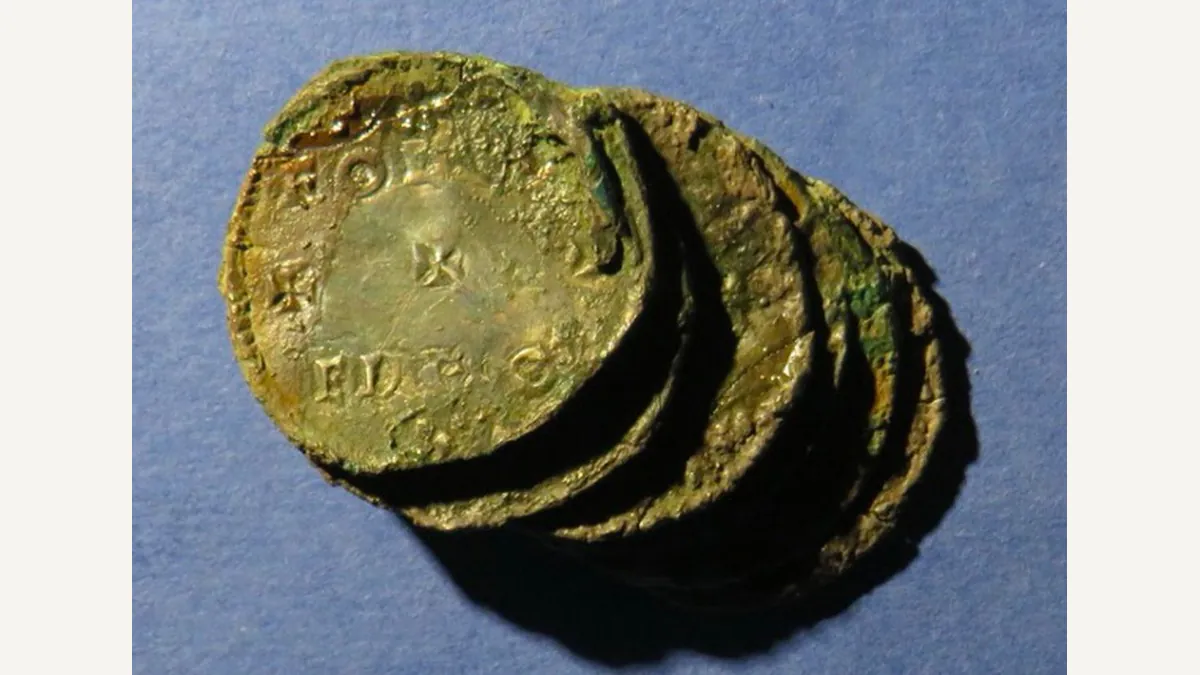
Twenty English coins found near the Vatican offer a wonderfully small window into a much larger journey. Nineteen silver pennies and one halfpenny, minted in tenth-century England, have emerged from excavations beneath the walled garden of Rome’s Palazzo della Rovere. Researchers interpret them as material evidence of the Schola Saxonum, an English community that made a home beside the Tiber.
The charming detail is the halfpenny. Among objects bearing the names of kings, it points toward the everyday business of a neighborhood: people making things, exchanging money, and getting on with life far from where their coins began.
Smithsonian’s October 6 report brings the findings into this week’s coverage. The originating University of Cambridge account , published October 1, explains the research and identifies the excavators and historians behind it. Excavation at the site began in 2020. This is a recent interpretation of a discovery, with a much older neighborhood at its heart.
A pocket-sized connection between places
The coins were minted in the names of Edward the Elder, Æthelstan, and Eadred. The researchers identified origins in East Anglia, Kent, London, and the West Midlands. Together, those places give the finds a more interesting character than a single grand royal gift. Money from different parts of England reached one small area of Rome.
Fourteen coins survived in two fused groups, containing six and eight coins, found in rubbish pits. The remaining English coins were scattered nearby. A millennium underground has made the groups less like a neat display of individual specimens and more like compact objects with several histories pressed together.
Their arrangement matters. The site yields a pattern of material evidence, rather than a surviving account of an individual purchase. There is no receipt naming a customer or listing what a penny bought. What the coins offer is a connection that can be examined: money struck in England ended up in the ground beside the Vatican.
That is enough to make the distance feel smaller. A familiar object traveled, was handled, and became part of another place. The pleasure of the discovery lies in that ordinary continuity, even when the people who carried it can no longer be identified.
A neighborhood comes into view
Medieval texts had already described an English quarter in this part of Rome. The Schola Saxonum background helps explain the institution’s connection with English pilgrims. The new material evidence gives historians another way to study a community they previously encountered primarily through writing.
The coins share their setting with evidence of leather, bone, and metal craftwork. Cambridge’s account places the area of craft activity at at least 3,000 square meters, while emphasizing that the size of the entire English quarter remains unknown. That combination suggests a place with work to do and things to exchange, as well as people arriving on pilgrimage.
Historian Rory Naismith describes a permanent community that may have numbered in the hundreds. Francesca Tinti and Naismith developed the interpretation from an initial study of the coins by Cecilia de Leone. Their chapter, written with Marzia Di Mento, Valentina Pica, and Filippo Salamone, appears in the 2026 volume Rome and the Others (300–1000).
The useful distinction is between a stopping place and a lived-in neighborhood. Visitors need somewhere to arrive. Residents also need the means to maintain everyday life. The craft evidence and small denominations make the second picture especially inviting: a community with practical routines, alongside its connection to Rome’s churches.
Why the smallest coin matters
A halfpenny is a modest object, yet the researchers consider this example particularly informative. Cambridge explains that the denomination is associated with trading centers where lower-value money changed hands. Its presence fits the possibility of everyday transactions within the quarter.
The English coins also raise a question about currency. Historians have generally understood Rome’s monetary system in this period through papal coinage. The researchers suggest that the English community may have been permitted to use its own money. The discovery helps them investigate a practical privilege, rather than merely a ceremonial connection.
That interpretation has a boundary. The coins do not preserve the terms of a currency agreement, and Cambridge’s account does not establish which ruler secured one. The researchers discuss the possibility of a connection with earlier arrangements involving Alfred the Great, while keeping that possibility distinct from a demonstrated deal.
For the reader, the distinction makes the story more interesting. An object can answer one question and open another. English money was there. Its setting supports an interpretation of community life. The precise arrangements that let it circulate remain a subject for historical study.
A name still beside the river
Rome retains hints of this English connection in present-day place names. Cambridge points to Lungotevere in Sassia, the embankment road between the Tiber and the Vatican, and to Santo Spirito in Sassia. The ancient community has left traces in the vocabulary of the modern city as well as in its soil.
The Palazzo della Rovere visitor information provides the setting for today’s reader. It is a location reference, rather than a promise that the excavation or coins are available for public viewing. The important invitation is to look at a familiar city with one additional layer in mind.
A riverbank, a place name, a cluster of coins, and evidence of making things can bring an old neighborhood surprisingly close. This discovery makes history feel inhabited. Beside the monuments and royal names, there were people building an everyday life, with a little money from home still passing through their hands.
The featured photograph is by Cecilia de Leone, courtesy of the Soprintendenza Speciale Archeologia Belle Arti e Paesaggio di Roma, as credited in the originating University of Cambridge account linked above. The original frame is proportionally reduced and neutrally matted for the article’s image formats.