This retrospective revisits the University of New England’s September 21, 2026 announcement about Casper. It does not report a new arrival or a new research result.
A familiar animal in an unfamiliar palette
The University of New England’s announcement introduced Casper as a rare white lobster donated by the Maine State Aquarium in Boothbay to UNE’s Arthur P. Girard Marine Science Center in Biddeford. The university said Casper would join its investigation of unusual lobster coloration, led by marine scientist Markus Frederich.
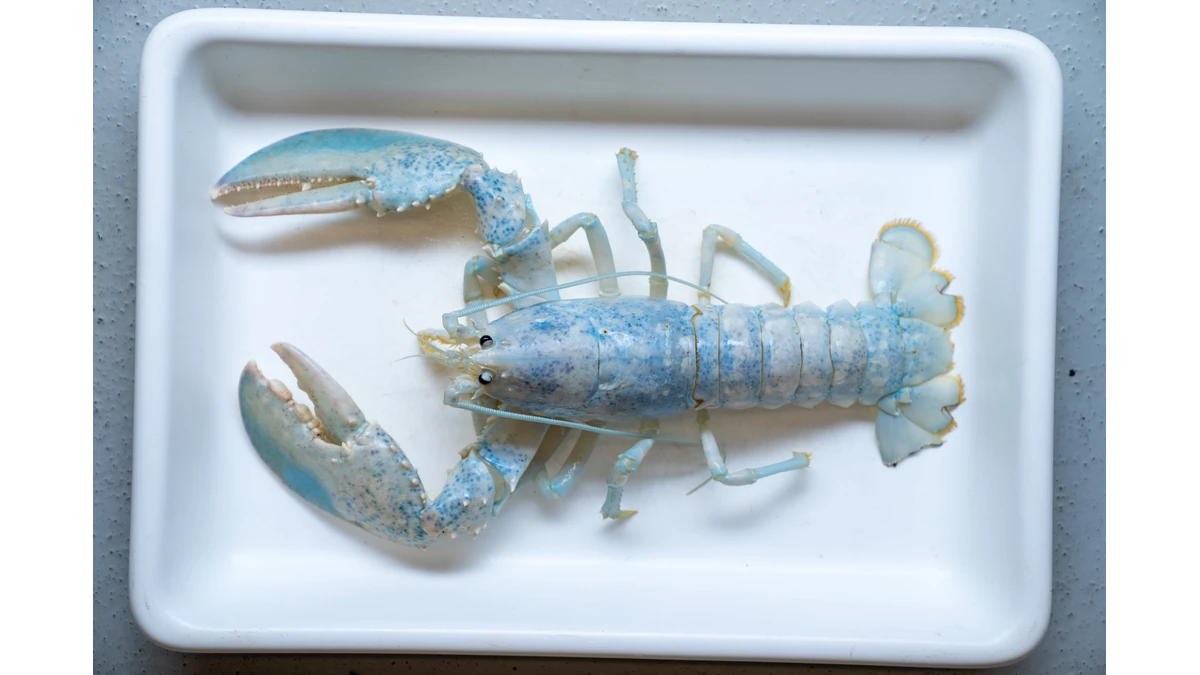
The official photograph offers a closer encounter than a rarity number. Casper rests in a light-colored tray, with the claws extending to either side of the head. Pale surfaces carry patches of blue speckling. The segmented tail, jointed legs, and long antennae remain recognizable, while the unusual palette changes how those familiar forms register.
That is part of the pleasure of looking. A viewer can recognize a lobster immediately and still find details that make this individual worth a second glance. The eye moves from the large claws to the smaller joints, then follows the antennae back toward the head. Against the tray, the animal’s edges become especially easy to trace.
The nickname adds warmth without requiring an invented animal personality. Casper’s story can be enjoyed through its appearance and through the human curiosity it invites. The rewarding question is what can be learned from an animal whose shell looks different from the expected pattern.
The American lobster reference provides species background for readers who want to place that appearance in context. Recognizing the animal is a starting point. Understanding the particular color calls for a different kind of investigation.
A visible color becomes a research question
The National Human Genome Research Institute’s phenotype glossary explains the distinction between observable traits and the genetic makeup associated with them. It also describes the role of environmental influences. A visible difference can give a researcher a question without supplying the complete biological explanation.
That distinction makes this story a useful introduction to scientific reasoning. We can describe what a shell looks like before deciding why it looks that way. Description should be specific enough that another observer can understand the feature being compared. An explanation then needs evidence that connects the visible feature to a biological mechanism.
UNE’s original rare-lobster research announcement establishes the program’s earlier work with unusually colored animals. That broader collection matters because a single striking individual can attract attention, while comparisons provide a way to investigate a pattern.
Consider the difference between two questions. Asking whether a lobster looks pale can be answered from an appropriate observation. Asking which biological differences are associated with that appearance requires additional information and a comparison that fits the question. The second question grows out of the first, but it asks for another kind of evidence.
A useful reading of future results would therefore keep the observed color, the measured biological feature, and the proposed explanation distinct. A connection between two features can guide further investigation. Explaining how one produces the other asks for a more detailed account. That progression gives readers a way to enjoy the unusual animal while following the research carefully.
Students can follow the question through its stages
In its September announcement, UNE described noninvasive study methods and undergraduate participation across the work, from handling the animals to genetic analysis. The appeal of the educational setting is that an immediately visible feature can lead students toward evidence they cannot see simply by looking at a shell.
There are several kinds of attention involved in such a question. Observing an animal requires noticing details consistently. Keeping records requires deciding which observations belong together. Comparing information requires identifying the feature under examination and the conditions that make the comparison useful. Explaining the result requires language precise enough to tell another person what the evidence supports.
Those are transferable habits of learning. They also help a reader distinguish a memorable photograph from a completed research finding. The picture makes the subject approachable. The investigation supplies the slower work of asking, comparing, and explaining.
The Arthur P. Girard Marine Science Center gives the story a concrete place on Maine’s coast. The Invertebrate Physiology Lab provides the research group’s own context. These links let an interested reader move beyond the nickname to the institutions carrying the work forward.
The combination is satisfying because curiosity has a practical destination. A surprising animal becomes a question that students can help investigate. The announced educational value lies in participating in that process, with observation and analysis connected by an actual research purpose.
A small encounter can widen the view
For related reading, Richard J. King’s author page introduces the writer of Lobster, published by Reaktion Books . The book explores lobster biology and the animal’s place in human culture. The verified Amazon Kindle edition of Lobster I may earn a commission offers that broader background. It predates Casper’s story and is not a report of this research project.
Casper’s pale shell offers a friendly invitation to look more carefully at a familiar creature. The university’s announcement gives that invitation a second purpose by connecting it to student learning and a biological question. The enjoyable part is the movement from surprise to curiosity: a recognizable animal, an unexpected appearance, and a reason to keep asking what lies behind the color.