The first volume of Zara and John Galliano’s Re{form} partnership approaches the retailer’s archive as material to work on. Shirts, tailoring, lace, and accessories provide starting structures. Cutting, enlarging, combining, and repositioning those structures creates the collection’s new proportions.
TheIndustry.fashion’s October 2 account dates the launch to October 1 and identifies the project as the first collection in a two-year partnership. Zara’s official campaign presents the work under Galliano’s authorship, with photography by Steven Meisel. The distinctive invitation is to notice how garments have changed their jobs.
A familiar object can carry a new silhouette
One technique enlarges an archival shirt to three times its original size and applies foil printing to suggest a leather coat. Another turns a lace dress into a ruffled neckpiece. These moves work at different scales, yet share a design principle: retain enough of the starting object to make its transformation legible.
An oversized shirt can borrow the volume of outerwear while preserving the references of shirting. A dress brought upward toward the neck redistributes visual weight. What once organized the length of the body becomes a concentrated frame around the head and shoulders.
That approach gives the collection a theatrical quality without making every effect dependent on decoration. Proportion can do the work. A change in pocket position shifts the perceived stance of a jacket. A long strip of fabric can redirect the eye across an otherwise familiar silhouette. The garment’s construction becomes part of its character.
The concept connects with deconstruction in fashion , where existing garment conventions can be exposed, displaced, or reorganized. Here the starting point is specifically Zara’s archive, and the central question is what another author can make from its recognizable forms.
Layering offers a different kind of structure
The reported techniques include layering garments to create the appearance of a coat, combining skirts, slips, and linings into wraps, and changing coat scale through reduction and enlargement. Each proposes a different relationship between a piece of clothing and the shape it presents.
Layering is especially interesting because the eye can read a unified outer silhouette while the construction remains composite. An apparently substantial coat may resolve into several lighter parts. The resulting movement and reveal become design features, although campaign photographs cannot establish how a particular piece feels or behaves in wear.
A wrap produces another kind of freedom. Its diagonal can interrupt the vertical logic of tailoring, and its overlap allows the body to participate in the shape. That is a useful way to read the collection’s contrasts: rigid and fluid, covered and sheer, conventional closures and reconfigured edges.
These contrasts also explain why the accessories matter. A collection built around altered proportion needs more than a neutral finishing shoe or bag. Headwear, gloves, straps, and collars can extend the same logic into smaller objects, giving the whole look a consistent sense of deliberate rearrangement.
Tri-Chic makes the transformation practical
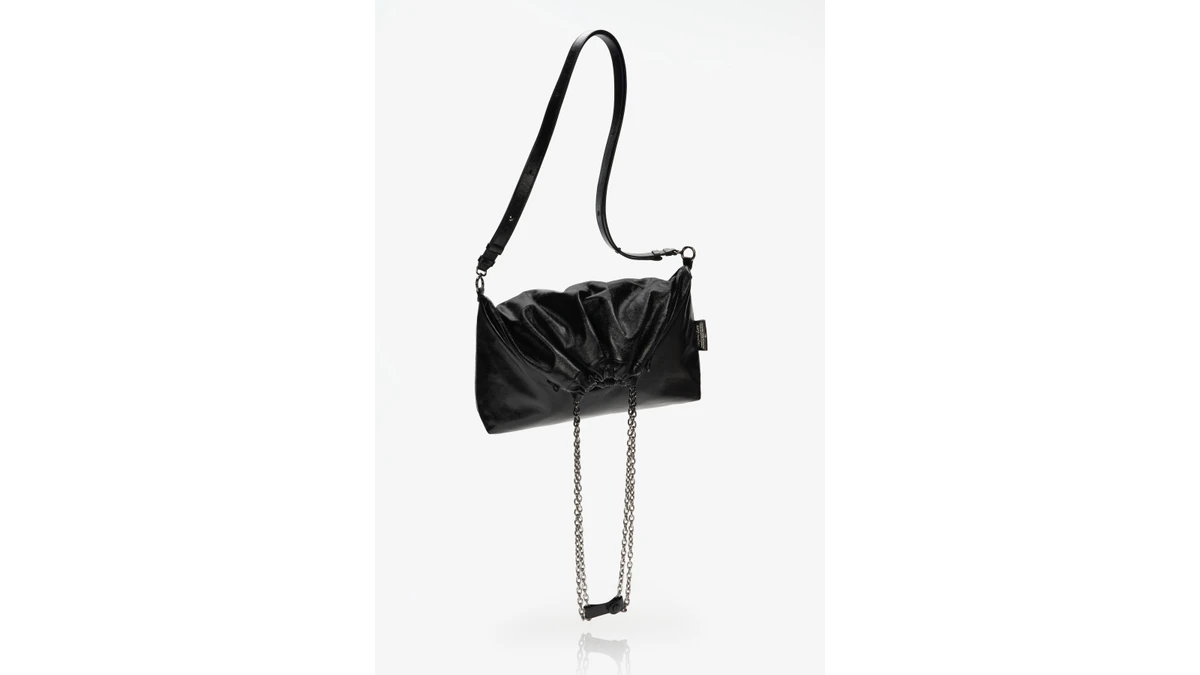
The Tri-Chic bag gives the collection’s idea a tangible everyday form. TheIndustry describes reversible configurations for carrying by hand, on the shoulder, or as a backpack. Zara’s UK large leather bag listing specifies a reversible, multi-position suede top, a metal handle, a detachable leather strap, and an inside zip pocket.
The official product photograph shows a soft black body gathered around its opening, with a long strap and a separate metal carrying element. Softness and hardware create different visual rhythms. The body can fold and contract, while the strap establishes a clear route for carrying it.
For a wearer, reversibility is meaningful when it changes access, carrying position, or the visible surface. A configuration that looks persuasive in a campaign still needs to suit the amount being carried and the way the bag sits against the body. The named functions provide a starting point for that judgment, while the actual fit and ease of conversion remain hands-on questions.
At the October 2 review, this UK listing displayed £469 and a coming-soon notice. That detail keeps the launch in focus: the collection is introduced, while a specific item’s stock and delivery position depend on its market and listing. A campaign’s breadth should not be mistaken for immediate availability of every pictured object.
Archive work carries a precise claim
Reworking an archive offers a compelling account of design authorship. A new shape emerges from a previous one, and the viewer can look for the traces of that change. It also places the collection within a conversation about reuse and circular fashion.
The demonstrated design process is narrower than a measured environmental result. Archive-derived construction does not establish a collection-wide reduction in emissions, waste, or resource use. Those conclusions require information about sourcing, production quantities, processing, and the destination of materials. The creative value can be described clearly without attaching an unsupported lifecycle claim to it.
The same precision applies to Galliano’s return. TheIndustry places the collection after the cancellation of a planned museum exhibition following criticism connected with his 2011 French conviction for antisemitic comments. That history remains material context for the collaboration. It does not change the observable construction of the clothes, and the collection’s design merits do not resolve the questions raised by that history.
A collaboration built to be read closely
Re{form} rewards looking at a garment in stages. First read the overall shape. Then identify the displaced pocket, enlarged component, changed closure, or combined layers that produce it. The most revealing comparison is between the object’s familiar function and the new one the design gives it.
For a longer view of the designer’s earlier construction and silhouette, Kerry Taylor’s Galliano: Spectacular Fashion on Amazon I may earn a commission covers collections from 1984 through 2015. Its close views of garments provide historical context for reading the new transformations. It predates Re{form}.
That makes this first volume a collaboration with a coherent visual argument. Zara supplies an archive and a retail setting. Galliano supplies an approach to cutting and transformation. The result’s interest lies in the new relationships between scale, surface, and use, with future volumes able to develop the same method beyond a single launch.