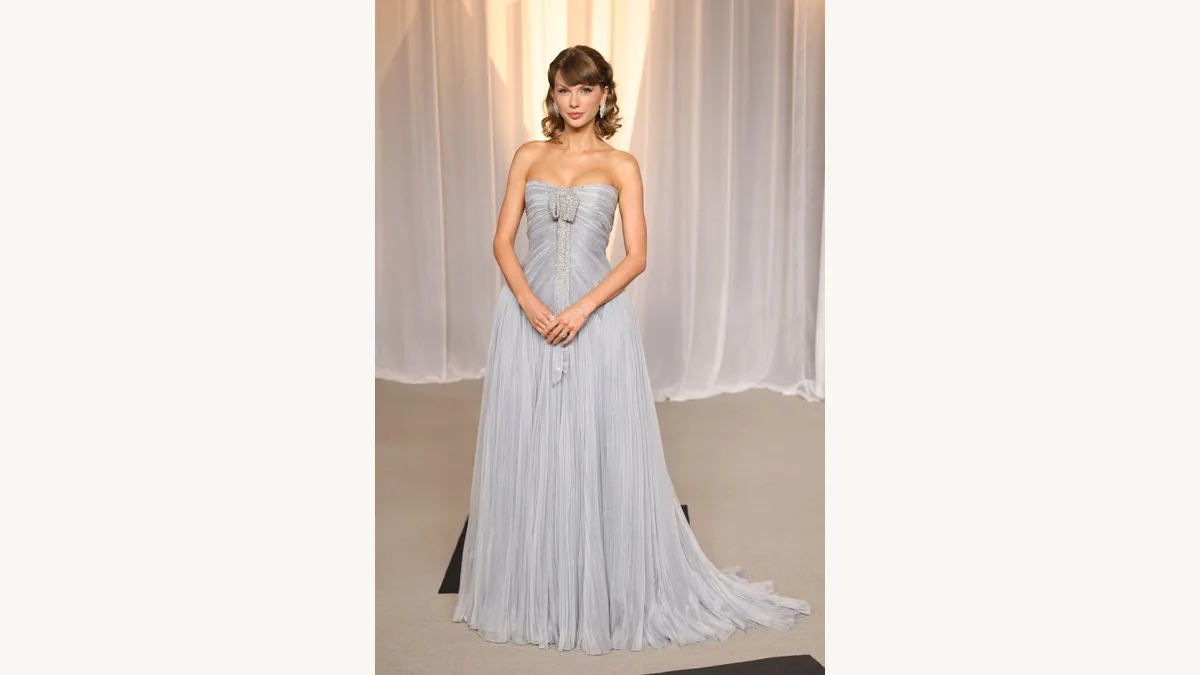
The dress sets a line, the hair loosens it
Taylor Swift’s icy-blue Dior gown and loosely curled bob make a useful study in contrast at the 2026 Academy Museum Gala. The dress establishes a defined outline. The hair interrupts that neatness with separate, rounded shapes. Together, they offer a way to read a formal outfit through the meeting of firm and soft edges.
British Vogue’s account identifies the custom dress as Dior by Jonathan Anderson and describes the shoulder-skimming hairstyle. W’s carpet gallery likewise identifies the arrival look as Dior. The credited Getty Images photograph lets the relationship between those elements be examined closely. The upper edge of the gown is easy to follow, while the curls break into individual turns around the shoulders.
The space between them is doing some of the work. A strapless dress leaves the neckline free of shoulder straps. In this photograph, that creates an interval between the upper edge of the garment and the ends of the hair. The two outlines remain distinct instead of joining into one continuous arrangement.
That interval makes the softer styling readable without requiring a competing ornament at the neckline. The hair supplies a change of rhythm. The gown can retain its own central detail. The eye has room to move between them, rather than having to interpret several overlapping shapes at the same point.
This is a description of how the photographed look works, not an instruction about which bodies or hairstyles belong in eveningwear. The useful question is compositional: where does an outfit make a clear line, and where does another element loosen it? Different clothes and different wearers can answer that question in different ways.
Pleats organize the pale surface
Dior’s own account of the dress , distributed by its Japanese company, identifies light-blue pleated silk and an embroidered ribbon. That description gives a more precise vocabulary for the garment than a general impression of a blue ballgown. It directs attention toward both the repeated folds and the central decoration.
In the selected photograph, the folds across the bodice appear closely arranged. Farther down, the skirt opens into longer vertical falls. The change in direction gives the pale material internal structure. A fairly restrained color can still contain considerable activity when light catches its folds at different angles.
The central ribbon provides another kind of line. Its concentrated embellishment draws attention to a small area before its trailing shape leads the eye downward. It is useful to distinguish that decorative emphasis from the garment’s unseen support. A photograph shows the surface arrangement, but cannot establish the complete internal construction.
Reading the dress this way also keeps the discussion grounded in the clothes. The interesting details are the placement of a fold, the direction of a line and the difference between a gathered surface and a falling skirt. None requires a ranking of the wearer’s appearance or a claim that one evening’s outfit establishes a wider fashion trend.
The curls introduce a different scale of repetition above all those pleats. Both elements repeat, but they repeat differently. The folds make the fabric look organized, while the separated curls make the upper outline less uniform. Softness here comes from the relationship between details, rather than from the absence of structure.
A second blue changes the emphasis
For her performance, Swift changed into a darker blue Ralph Lauren dress. Harper’s Bazaar’s account identifies a crystal-embellished Spring 2027 design, with gathering across the bodice, a layered sheer skirt and pockets. Its report describes an adjustment to the collection look with added tulle.
The two dresses keep a connection through blue and a strapless outline. Changing the shade and surface gives the second look a different emphasis while leaving those points of continuity intact. The comparison is between these two documented outfits. It does not depend on assuming a private message behind the color choice.
That is a useful distinction for anyone thinking about dressing across an evening. Continuity can come from a small number of repeated decisions. It does not require every accessory, material and silhouette to remain identical. Holding one element steady can make a change elsewhere easier to notice.
Here, the palette supplies that connection. The pale Dior dress puts its folds and central decoration into a light field. The deeper blue performance dress, as documented in Bazaar’s photographs, gives the embellishment a darker setting. The contrast changes how the surface reads without abandoning the evening’s color family.
The Academy Museum’s announcement places the October 17 event in Los Angeles and identifies Swift as its performer. That context explains why the evening includes both an arrival look and a stage look. It does not establish how either garment felt during movement, which remains outside what these photographs and accounts can show.
The most transferable idea is the way repeated choices coexist with variation. A neckline can remain clear while curls soften its surroundings. A color can connect two dresses while their surfaces change. Looking at those relationships offers more to take away than deciding which outfit wins: it shows how a formal look can hold together while leaving individual details room to breathe.