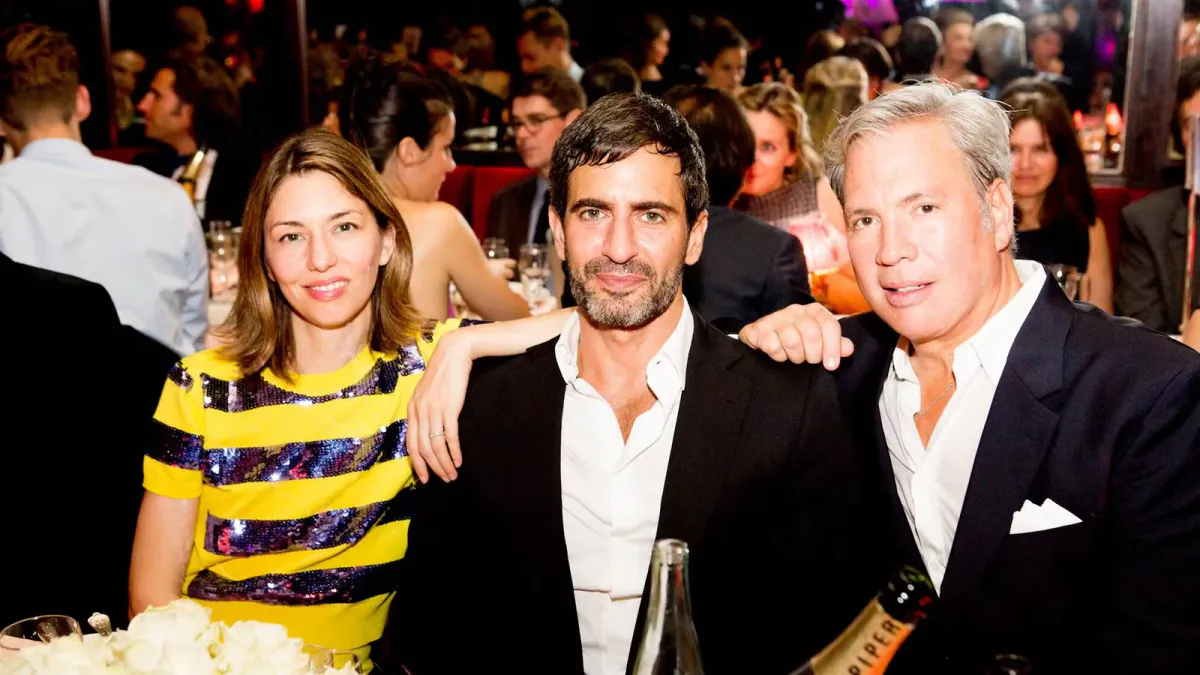
Marc Jacobs has changed owners without surrendering its creative centre. After nearly three decades at LVMH , the New York house now belongs to a partnership between WHP Global and G-III Apparel Group. Marc Jacobs remains founder and creative director, preserving the authorship behind one of American fashion’s most recognisable points of view.
The deal is distinctive because the brand name and the business that brings it to market sit in separate, connected structures. WHP Global and G-III jointly own the Marc Jacobs intellectual property. G-III owns and operates the commercial business through a long-term licence, taking responsibility for wholesale, retail, and e-commerce.
That architecture gives the next chapter a clear tension. Jacobs retains the creative reins, while a new ownership system takes charge of how his collections, accessories, stores, and image travel through the world.
A new framework for an unmistakable name
The G-III closing announcement places WHP Global and G-III in equal ownership of the intellectual-property venture, with each holding 50 percent. WHP leads the venture and its global licensing activity. G-III owns and leads the operating business, including wholesale, retail, and e-commerce.
A G-III filing with the US Securities and Exchange Commission confirms that the transaction closed on September 1, 2026. It also reveals the depth of the operating agreement. The licence covers ready-to-wear, handbags, footwear, swim, small leather goods, luggage, and cold-weather accessories across the United States, Canada, Mexico, and Western Europe. Its initial term runs through December 2041, with renewal provisions beyond that date.
Independent trade reporting gives the sale its scale. TheIndustry.fashion reported a value of $925 million after 30 years of LVMH ownership, with the operating business centred on the United States and Europe and encompassing about 100 stores. Drapers also reported the completed sale , adding a separate trade-news account of the closing.
The result is not a clean break with the past. It is a transfer of the commercial frame around a designer whose name, hand, and public presence still define the house.
Creative continuity is the deal’s most valuable thread
Keeping Jacobs in place matters because the brand has always depended on the particular fluency of its founder. His work moves between polish and perversity, American sportswear and theatrical flourish, downtown attitude and grand fashion gesture. Even when the product mix broadens, the house is legible through that tension.
The formal continuation of his role secures authorship at the point where ownership could otherwise blur it. Runway collections and fashion shows remain under the direction of the designer who built the label with Robert Duffy in 1984. The buyers gain a famous name, but they also retain the living creative intelligence that made the name valuable.
That continuity should not be mistaken for institutional sameness. Collections are shaped by more than the studio. Merchandising calendars, category investment, production capacity, wholesale commitments, store design, pricing, and campaign budgets determine which ideas reach customers and in what form. Those decisions now move through a new operating system.
Licensing can extend the wardrobe without diluting it
The ownership split gives two specialist organisations distinct jobs. WHP can pursue licensing opportunities and new markets. G-III can apply its sourcing, distribution, and retail infrastructure to the core business. In principle, that division could let the house expand while Jacobs and his studio concentrate on the creative proposition.
For fashion, the measure of that strategy will be coherence rather than volume. A licence earns its place when it extends the wardrobe and carries the house’s design codes into a category with conviction. It weakens the proposition when the name becomes the most considered element of the product.
Marc Jacobs enters this structure with unusually elastic codes. The house can accommodate sharp tailoring, extravagant silhouettes, playful accessories, democratic diffusion, and collectible runway pieces without losing its identity. That range is an advantage, but it also demands careful editing. The more categories and territories the owners add, the more exacting the creative direction must become.
The central question is therefore not whether the new structure can make Marc Jacobs larger. It is whether licensing, operations, and the studio can share one vivid definition of Marc Jacobs.
The next collections will make the strategy visible
The earliest evidence will arrive through product and presentation. New licences will show which categories the owners consider natural extensions of the house. Store openings and closures will reveal where direct retail matters. Wholesale changes will indicate whether the collections are becoming more selective, more widely available, or differently positioned.
Pricing will be just as expressive. Marc Jacobs has long moved across luxury ready-to-wear, cult accessories, fragrance, and more accessible propositions. The new owners inherit that breadth. Their task is to make each level feel connected to the same creative world rather than assembled as separate businesses under one signature.
Campaigns and fashion editorial photography will provide the most immediate visual reading of the transition. The stronger test will sit beneath the images, in the garments, accessories, stores, and distribution choices that give those images substance.
For now, the transaction offers a rare kind of continuity. Marc Jacobs has left the luxury group that housed his label for three decades, yet he remains at the creative helm. Around him, the brand has acquired a new commercial apparatus with the reach to extend its world. The opportunity is to let that machinery serve the singularity already there.