A jeweled structure, rather than a decorated surface
Kylie Jenner’s Victoria’s Secret runway debut on October 18 brought back the Fantasy Bra with a construction puzzle at its center. Jewelry can hang from a garment, but this Jacob & Co. collaboration asks precious metal and stones to do the garment’s work themselves. Its interest begins with that change in responsibility.
In its making-of account , Victoria’s Secret connects the design to the jeweler’s Rare Touch collection. The company describes a flexible arrangement of articulated metal parts. Its stated aim is to let the piece follow the wearer’s movement. That is a maker’s account of the construction, rather than a firsthand assessment of how it feels to wear.
The distinction is useful when looking at elaborate clothing. A fabric foundation can carry beads while providing the underlying shape and give. Remove that foundation and the decorative material has to help form the object. A joint then becomes more than a place to attach another stone. It becomes a point where a rigid material can change direction.
The brief background on Jacob & Co. places the collaboration within a jewelry practice. Here, that background helps explain the meeting of disciplines: a jeweler approaches the bra as an articulated object, while the runway requires it to remain legible as clothing. The same piece has to answer both descriptions.
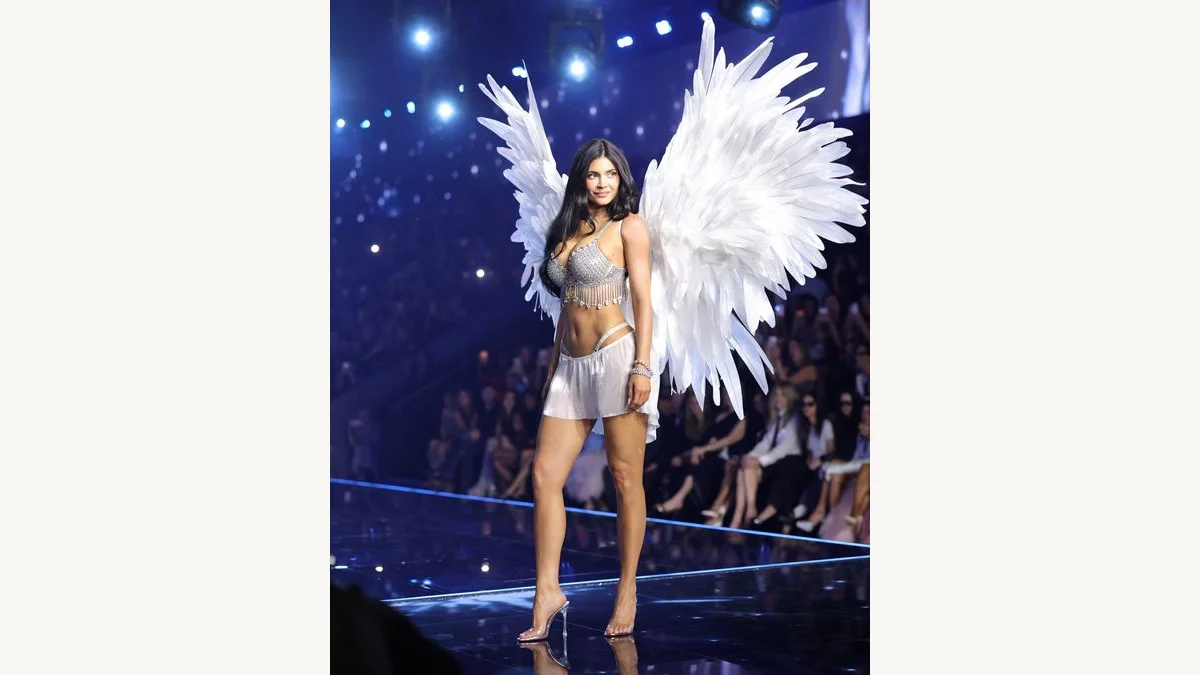
That does not mean every construction detail is visible from a runway photograph. What the image can show is the relationship between the dense jeweled cups, the straps, the central connecting elements and the hanging fringe. Knowing what to look for turns an initially dazzling surface into a set of different visual tasks.
Two kinds of movement
Hypebeast’s construction account reports 3,218 individually designed components and a fringe along the lower edge. The component count describes complexity. It does not, on its own, explain which parts carry tension or how the complete piece distributes its load.
The fringe offers a more immediately readable clue. In the credited runway photograph, its narrow pendants extend below the curved, closely set surface above. Their separate outlines make the lower edge look less fixed than the cups. The construction account describes flexibility within the structure, while the photograph makes the possibility of movement visible at its border.
Those are two different ways to suggest softness. One concerns the ability of the object to follow a moving person. The other concerns what the eye reads from its outline. A fringe can make an edge appear lively even in a still image. It cannot establish whether the supporting structure is comfortable, light or practical.
That separation gives the reader a useful viewing method. Look first at the broad shape, then at the parts that connect it, and finally at the loose edges. Each scale can contribute something different. A single impression of sparkle tends to flatten those distinctions, treating the whole object as one reflective surface.
Here, the lower edge keeps the jewelry idea visible. The cups make the clothing reference recognizable. Their coexistence gives the design its tension: it reads as a familiar garment while continually revealing that its material belongs to another craft.
White wings give the metal room
Harper’s Bazaar’s runway report identifies Jenner’s white miniskirt and feathered wings alongside the jeweled centerpiece. In Frazer Harrison’s accompanying photograph, the wings create a broad pale outline around a much more concentrated field of reflective detail.
The contrast works at several distances. From farther away, the wings supply the silhouette. Closer in, their long feathers direct attention toward the smaller central object. The skirt continues the pale framing below it without repeating the bra’s dense pattern. The dark blue background in Harrison’s photograph makes the feather tips particularly easy to distinguish. It also shows why a close crop would lose part of the argument: the surrounding outline helps establish the scale of the central piece. These are observations about the photographed styling, rather than a claim about the designer’s private intentions.
There is a helpful lesson here for looking at maximalist outfits. More detail does not have to mean the same amount of detail everywhere. A large, relatively continuous area can give a smaller, intricate object enough visual space to register. Scale and texture can separate the elements even when all of them are theatrical.
The revival also carries a recognizable show reference. British Vogue’s interviews with the collaborators connect the Fantasy Bra’s return to requests from fans, according to Victoria’s Secret creative chief Adam Selman. Vogue reports a $50 million valuation. That figure is a reported value for the showpiece, not an independently established retail price or production bill.
It is the easiest number to remember and the least useful guide to reading the outfit. The more rewarding detail is smaller: the change from a closely set surface to a loose pendant, or from metal to feather. Those transitions let an extravagant runway object reveal a precise fashion question about how something solid can look ready to move.