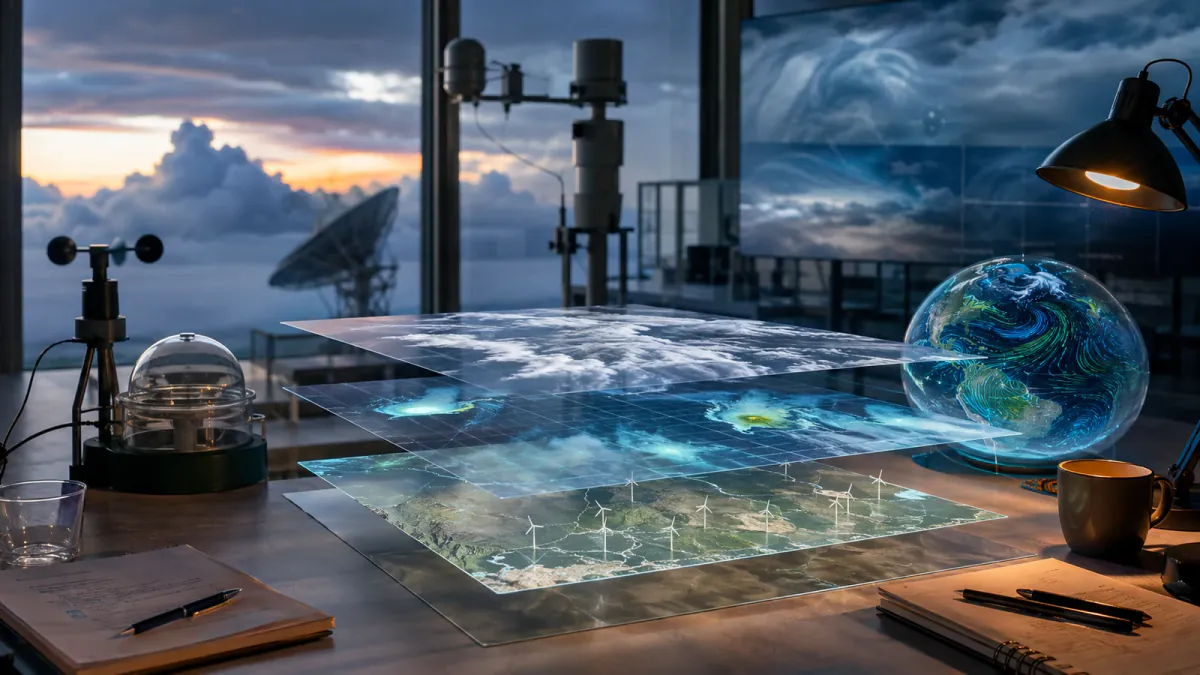
An app can show a detailed weather map without making its age equally clear. If a new forecast is produced every hour, the run on screen still needs to be identified. Google’s WeatherNext 3 makes that small piece of interface information more useful by shortening the route from fresh observations to a global forecast.
The September 3 announcement describes hourly satellite input, selected surface grids as fine as 5 kilometers and distribution across Google products and cloud services. This first look follows that release record. The technical change is the tighter observation-to-forecast loop, with the application responsible for making the result’s time and uncertainty understandable.
A finer grid can show variation that a broader one smooths away. A newer run can begin with a more recent view of the atmosphere. Those advantages answer different questions, and neither removes the need to evaluate the forecast for its variable, region and lead time.
Follow the satellite observation into the next run
In its WeatherNext 3 announcement , Google says the model ingests hourly mosaics from geostationary satellites alongside traditional historical analysis. A Functional Generative Network mesh transformer produces gridded fields, cyclone tracks and station-level forecasts through one architecture.
Many AI forecasts learn from numerical weather prediction analyses, where observations and physics-based models help estimate the atmospheric state. Producing those analyses takes time. Direct satellite input gives WeatherNext 3 a more immediate view of changing cloud systems between those traditional cycles.
Sparse weather-station observations provide another training target. They connect broad fields with measurements at individual locations, where terrain and coastlines can affect temperature and humidity. Satellites and stations offer different views: frequent coverage over large areas and direct observations at irregular points.
The output’s detail varies by field. Google describes 5-kilometer grids for key surface variables such as temperature and moisture,10 kilometers for other surface fields and 25 kilometers for atmospheric variables such as wind speed. WeatherNext 2 used 25-kilometer grids at six-hour intervals. The smallest number does not describe every output.
A coastline or valley may therefore remain more visible in one field than another. The grid still represents an area. An app that places a marker at an exact address needs to keep that distinction legible, especially when the marker’s apparent precision exceeds the underlying forecast.
A sharper rain map still needs a measured result
Rain can form and change at scales smaller than a global model’s grid. A forecast may locate the larger weather system while smoothing a sharp precipitation edge or missing an intense local cell. That gives a detailed-looking rain map a demanding test.
Google says WeatherNext 3 was trained with NASA’s Integrated Multi-satellite Retrievals for GPM dataset and a Google precipitation reanalysis derived from satellite radar. In Google’s reported medium-range evaluations, the model improved Continuous Ranked Probability Score by as much as 60 percent against IMERG, 30 percent against the US Multi-Radar/Multi-Sensor system, and 10 percent against rain-gauge measurements at early lead times.
Those are Google’s reported evaluations against particular references. Continuous Ranked Probability Score examines a probabilistic forecast across possible outcomes. A percentage improvement in that score is different from saying that the forecast is that much more accurate everywhere. The reference data, lead time and event definition belong beside the number.
Calibration adds a question someone can understand over repeated forecasts: do events given a particular probability occur at roughly that frequency? Independent live comparisons across seasons and regions can examine that behavior alongside rare extremes. An aggregate score may leave a local weakness difficult to see.
Check which hour reached the screen
The September 3 release said WeatherNext 3 would begin powering Google Search, Gemini, Maps, the Google Maps Platform Weather API and Earth Engine. BigQuery and Earth Engine offer query access, with bulk data through Cloud Storage. Those are the announced distribution paths, rather than a claim that every application exposes the same field or control.
A researcher can compare hourly fields across regions. An app developer can use the data without running the model. Renewable-energy planning can use the announced 100-meter wind, cloud-cover and solar-radiation variables. Each use asks for evidence at a different scale and over a different decision window.
A casual outdoor plan and an emergency response cannot assign the same authority to one forecast field. Operational uses need validated performance, clear run times, monitored freshness and a fallback. Official forecasts, severe-weather warnings and public-safety advisories belong with the relevant local or national meteorological authority.
The timestamp helps make that boundary practical. Which run is displayed? Did the expected observations arrive? Is the application still serving an older field after the next update was due? An hourly production schedule and a current screen are two parts of the same delivery chain.
The global field meets a local decision
A consistent global dataset can broaden access to detailed fields where observation networks and regional computing resources differ. The opportunity is a common technical layer that local researchers and services can examine, compare and build upon.
Local expertise still connects the field to terrain, measurement gaps and community needs. Calibration in one region does not supply it for another. Availability gives that work another input, with sustained regional evidence needed to establish how well it serves each use.
The next evidence comes from that continued comparison: seasons, variables, forecast horizons and high-impact events. A sharper map and faster update create useful possibilities. The record of what those forecasts get right, and where, gives them their working value.
Back on the screen, a small time label tells the reader which forecast they have. It cannot make the rain prediction correct. It lets someone connect the map to the observation cycle behind it, and recognize when the next update has not reached them yet.