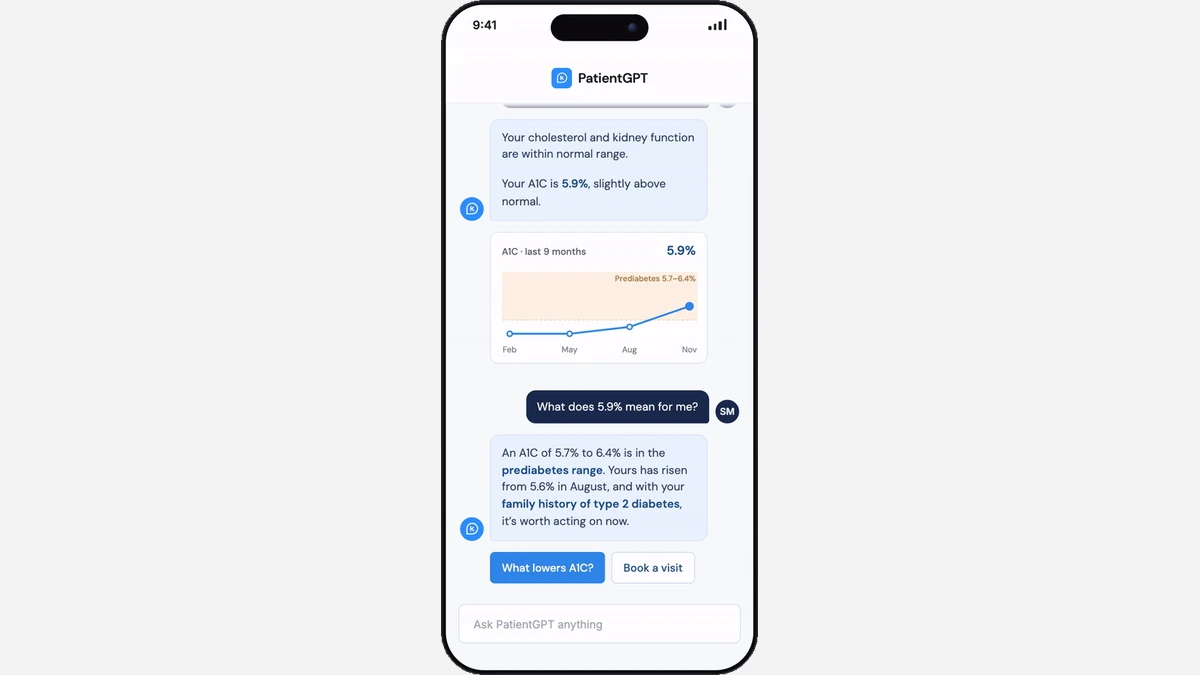
A question about a lab result can be the start of a useful conversation. Add the person’s medical history and a connection to their care team, and that conversation has somewhere to go.
This analysis revisits OpenAI’s November 16, 2026 healthcare announcement. Its ChatGPT for Healthcare announcement introduces computer-use agents, improved clinical search and more than 20 new healthcare plugins. K Health brings a practical perspective to that ecosystem: connect the conversation with the patient’s record and the people who provide their care.
OpenAI brings healthcare tools into the conversation
OpenAI is extending ChatGPT into the information and software healthcare teams use. Computer-use agents can navigate existing applications. Clinical search connects questions with medical evidence and inspectable citations. Plugins bring specialized services into the workspace.
That combination gives OpenAI a role beyond answering individual questions. It is building a place where teams can bring information together and carry work forward across systems. Organizations set application access and human-review steps, with eligible services and a business associate agreement supporting HIPAA-related workflows.
Other organizations named in OpenAI’s announcement include:
The practical appeal is continuity. A clinician’s question can sit alongside the relevant evidence and a tool for the next task, within a workspace configured for the organization. K Health’s contribution makes that idea concrete at the point where a patient conversation becomes a clinical visit.
K Health gives the conversation context
K Health describes its approach as an intelligent front door to a health system. PatientGPT brings together patient questions, information from an electronic health record and connections to clinical care.
The record gives the conversation a personal reference point. A question about a result can be considered alongside available medical history. The connection to the health system gives the patient a way to continue toward an appointment or a conversation with a clinician.
K Health’s official description keeps clinicians central to that journey. Its platform can hand a conversation to a clinician with the conversation attached, while the health system sets its own handoff thresholds. That design treats the patient’s explanation as something worth carrying forward into care.
The useful idea is simple: context and a next step belong together. A person asking a health question can begin with their own situation, then continue within the organization that provides their care.
Partnerships turn the idea into a service
Hartford HealthCare and K Health’s March launch announcement described PatientGPT as a round-the-clock educational connection to the clinical care team. Fierce Healthcare’s reporting covered the initial beta for adults in Connecticut.
Atlantic Health’s August announcement then described a New Jersey beta linked to MyChart records and virtual primary care. Becker’s Hospital Review reported Atlantic as the third deploying system, following Hartford and Novant.
These partnerships show how K Health’s approach fits into an existing care organization. The health system supplies the clinical setting, patient-record connection and care destination. K Health supplies the conversational experience and intake capabilities that connect those parts of the journey.
That combination gives K Health a distinctive position: its work spans the patient’s first question and the clinical workflow that can follow. The conversation is part of a service, with a recognizable care team at the other end.
K Health also supports the clinician’s side
OpenAI’s K Health plugin listing describes how record-aware patient intake prepares information before a visit. Clinicians can view a pre-populated chart, schedule, visit history and preferred pharmacy. The listing specifies read-only access through a work account for verified scheduled sessions.
PatientGPT and the plugin serve complementary audiences. PatientGPT supports the patient-facing conversation. The plugin brings K Health’s clinician-facing information into the ChatGPT workspace. Together, these roles illustrate the value of connecting patient access with visit preparation.
OpenAI’s platform strategy creates room for specialized healthcare services. K Health brings the record context, intake and care connections that give one of those services its practical purpose. The result is a useful way to understand this stage of healthcare AI: follow the conversation from the patient’s question to the clinician preparing to help.
FAQ
What does PatientGPT bring to a patient’s conversation?
K Health describes PatientGPT as a health-system service that connects questions with available medical-record context and a path to the care team. Its health-system deployments bring that experience into the organization’s own care environment.
How does K Health fit into OpenAI’s healthcare ecosystem?
OpenAI lists a K Health plugin for clinician visit workflows. It brings information from record-aware patient intake into a clinician’s ChatGPT workspace, complementing K Health’s patient-facing PatientGPT offering.