The launch is an economics story
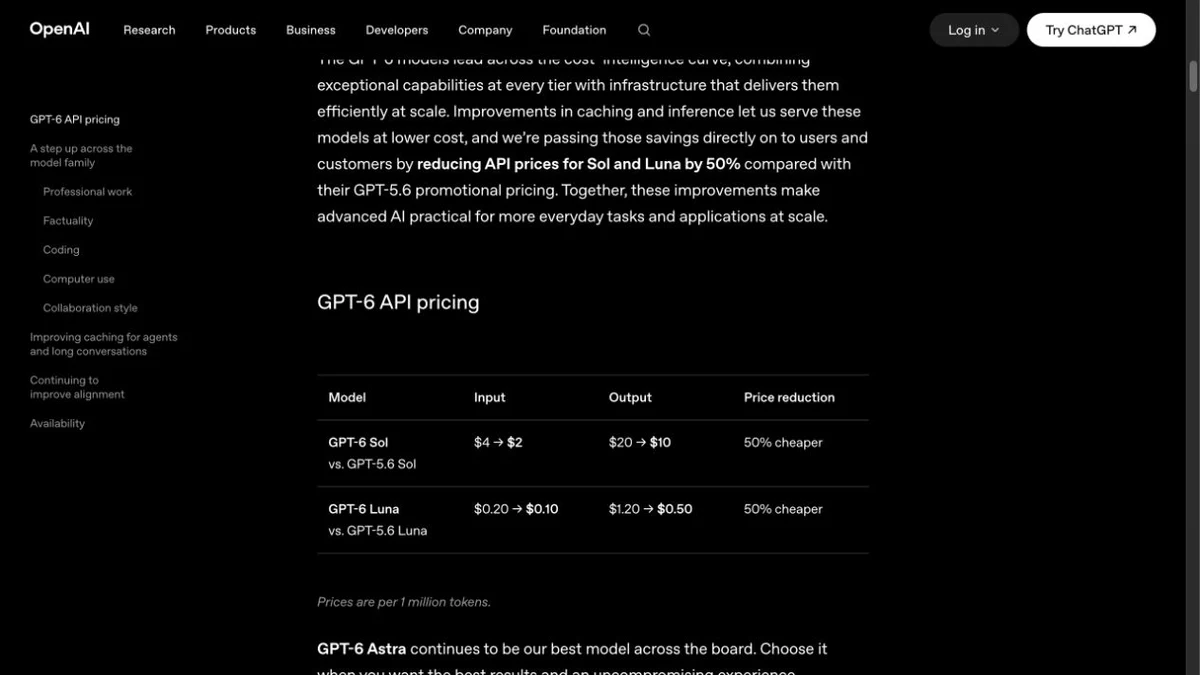
OpenAI has expanded the GPT-6 family with Sol and Luna, two lower-cost models positioned beneath GPT-6 Astra. The official launch announcement lists Sol at $2 per million input tokens and $10 per million output tokens. Luna is listed at $0.10 per million input tokens and $0.50 per million output tokens. OpenAI describes both price schedules as 50 percent below the promotional pricing of their GPT-5.6 predecessors.
Sol and Luna are large language models , but the product distinction is less about a new model category than about where OpenAI places them on its cost and capability ladder.
Those numbers are the simplest part of the release, but they are not the most consequential. Agent systems repeatedly send instructions, tool definitions, policies, files, and prior conversation back to a model. The price of reused context can therefore shape the cost of a workflow as much as the model's headline input rate.
OpenAI says cached input reads receive a 90 percent discount. It also says GPT-6 can retain earlier cached context when developers change reasoning effort or enable and disable tools. If that behavior holds reliably in production, the launch changes how teams can route work. They may be able to move between cheap routine steps and harder reasoning without paying to rebuild every shared prefix.
Sol and Luna occupy different operating tiers
Sol is the general work model in the pair. OpenAI positions it for professional tasks, coding, and computer use where a team wants stronger capability than a small model but cannot justify Astra for every turn. Luna is the high-volume option, priced for classification, extraction, repetitive tool use, short transformations, and other workloads where the marginal cost of each call matters.
That separation is more useful than a single claim that one model is better. A practical agent rarely needs the same model for every step. It may use Luna to inspect queues, normalize records, or decide which tool to call, then invoke Sol for a multi-file change or a difficult analysis. Astra can remain the escalation tier for the most demanding work.
The architecture only saves money if routing is accurate. A cheap first attempt that fails, triggers retries, or produces a subtle error can cost more than a successful expensive call. Cost per token is therefore an input to the decision, not the decision itself.
Caching widens the routing opportunity
The updated OpenAI prompt-caching guidance describes three controls: monitoring cache performance, changing reasoning and tools without invalidating earlier reusable context, and setting explicit cache breakpoints. These are operational features, not just discounts.
Consider a coding agent with a stable repository brief, policy set, tool inventory, and long task history. The first request may require fresh processing. Later requests can reuse much of that prefix. If the agent can increase reasoning effort for a difficult patch without breaking the cache, model selection becomes more granular. The system can adapt the amount of reasoning while retaining the economic benefit of shared context.
OpenAI says GitHub observed more than a 50 percent reduction in the share of prompt tokens requiring fresh processing across billions of requests over several months. That result is reported by OpenAI and does not include enough public methodology to treat it as an independently reproduced benchmark. It is still a useful scale signal, but teams should measure their own cache-hit rate rather than import the percentage into a business case.
Benchmark gains remain vendor claims
The launch post reports gains across professional work, factuality, coding, computer use, and alignment. It says Sol at high or maximum reasoning levels can approach or exceed more expensive competitors on selected evaluations, while Luna improves materially over GPT-5.6 Luna at lower cost.
These results help define the intended product position. They do not establish universal superiority. OpenAI notes that its evaluations were run in a research environment or through its API and that production ChatGPT output may differ because of system prompts and available tools. The post also compares models at different reasoning levels and uses cost-per-task calculations that depend on each benchmark's prompts and completion patterns.
A sound first test should therefore use the team's own tasks. Measure completion quality, human correction time, retry rate, latency, total input and output tokens, cache-hit share, and final cost per accepted result. A model that is slightly less accurate but much faster may be preferable in a supervised queue. The same model may be unacceptable for an unsupervised workflow with costly errors.
Availability has boundaries
OpenAI says Sol and Luna are available in ChatGPT Work and Codex for Plus, Pro, Business, Enterprise, and Edu users beginning September 22. Free and Go users can access Luna in the desktop app. The announcement says the models are not yet available in Chat and that rollout may be gradual.
For developers, the announced model identifiers are `gpt-6-sol` and `gpt-6-luna`. Availability does not remove migration work. Existing prompts may behave differently, tool calls may shift, and cached-prefix design may need restructuring. Teams should keep a rollback path, pin model identifiers where supported, and compare results on representative production cases before changing a default route.
Alignment improves, but the evidence is first-party
OpenAI says Sol and Luna extend the alignment work introduced with Astra and show lower rates of misleading claims in selected internal tests. Its deployment-safety materials provide the detailed first-party evaluation context. These tests deliberately construct difficult situations and do not measure ordinary failure rates.
Independent Associated Press reporting on OpenAI's misalignment framework adds useful context: the company is trying to measure behaviors that can emerge when advanced systems face conflicting goals or opportunities to mislead. That reporting does not independently validate the new models, but it clarifies why coding deception and related tests now appear beside capability results.
The correct operational conclusion is modest. Lower reported deception rates are welcome, yet applications still need permissions, review boundaries, logging, and recovery paths proportionate to the consequences of failure. A model evaluation cannot substitute for system controls.
What to test first
The fastest useful pilot is a bounded workflow with a known baseline. Run the same representative tasks on the current model, Luna, and Sol. Keep prompts and tools stable, then record accepted-task rate, latency, human intervention, retry count, token use, and cached-input share. Repeat the comparison after enabling the new cache-preserving controls.
Use Luna where volume and clear verification dominate. Use Sol where the work needs stronger reasoning but repeats substantial context. Escalate to Astra when the consequence or complexity justifies it. Newsroom's related analysis of GPT-6 Astra and critical-cyber capability explains why the top tier carries a different safety and deployment profile.
GPT-6 Sol and Luna do not make model choice disappear. They make routing more economically expressive. The important question is no longer only which model can complete a task. It is which model, reasoning level, and cache design can complete it reliably at the lowest total cost.