A flight experiment with a defined job
Google ’s October 1 announcement says the team has established contact and that the satellite is operating as expected. Built with Planet and launched by SpaceX , the spacecraft will collect in-orbit data over the coming weeks. That gives the mission a concrete purpose: observe how its Tensor Processing Units behave in the environment where a future system would have to work.
Tensor Processing Units , or TPUs, are accelerators designed for machine-learning computation. Their usefulness in an orbital system depends on more than whether a chip can perform an operation. Power delivery, cooling, communication, error handling, and the spacecraft around the processor all affect the amount of useful work a system can sustain.
The important distinction is between reaching orbit and establishing a dependable computing service. Contact confirms that a communication path exists. An operating spacecraft can then collect measurements. A service would also need a repeatable workload, predictable availability, and an acceptable way to handle faults. The launch moves the project into a setting where some of those engineering questions can be studied directly.
It is a useful progression because environmental testing on the ground and operation in flight answer related questions at different levels. A component can pass an individual test yet behave differently when its supporting systems share a spacecraft. Flight telemetry lets engineers compare their expectations with the behavior of the assembled hardware.
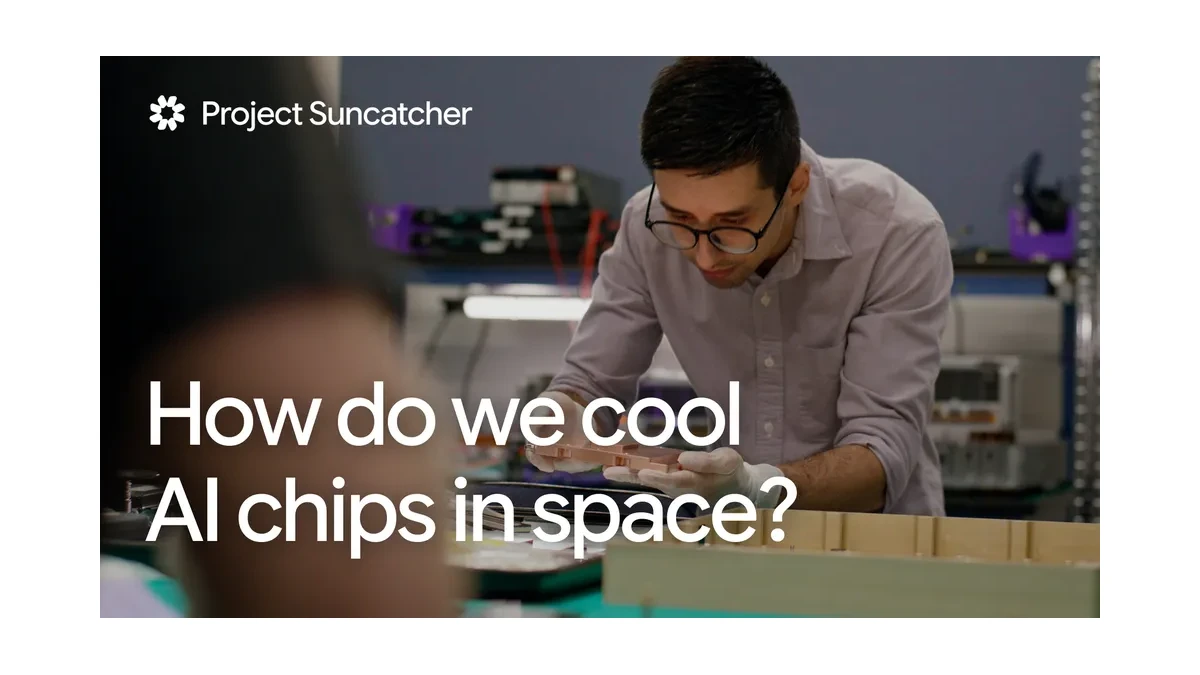
The thermal problem is a system problem
Space supplies abundant sunlight in favorable orbits, but disposing of computing heat requires its own design. NASA’s small-spacecraft thermal-control reference explains that heat transfer in a vacuum relies on conduction and radiation rather than external air convection. Within a spacecraft, structures can carry heat toward surfaces that radiate it away.
This matters because a processor’s electrical power ultimately becomes heat that the spacecraft must manage. A cold background does not provide the equivalent of air flowing through a server room. The route from the chip to a radiating surface remains part of the engineering task, alongside the heat absorbed from the Sun and the surrounding orbital environment.
For an AI workload, sustained operation is therefore as revealing as a brief successful calculation. Temperature can determine how long hardware runs at a given operating level. A useful test result would connect workload, power, temperature, and time, allowing readers to understand the conditions behind an announced performance figure.
Google’s September 24 project explanation describes heat pipes and radiators as part of the cooling approach. The design connects computing hardware to familiar spacecraft thermal methods. Its performance in orbit will depend on the complete arrangement, including how much heat reaches those radiators and how effectively they reject it under operating conditions.
Radiation and networking set different tests
The same project explanation describes ground testing of TPUs under proton radiation. Those tests supply evidence about components under specified exposures. The flight experiment adds observations from the actual spacecraft environment. A clear account of future results should identify the hardware tested, the exposure or operating conditions, and the observed behavior.
A processor that remains responsive can still experience recoverable errors or interruptions. Useful reporting would distinguish those outcomes from a permanent failure. For a practical computing system, recovery time and the amount of work lost can matter alongside the headline fact that a chip survived.
Google’s original architecture proposal also envisions satellites connected through optical links. That introduces a separate scale of work. Running a workload on one spacecraft tests local computing. Sharing computation across several spacecraft adds communication, coordination, and formation geometry to the problem.
The reason is straightforward. Distributed machine learning requires parts of a computation to exchange information. If communication takes too long, processors may spend more time waiting. A constellation therefore needs a design in which computing capacity and communication capacity are considered together. A working individual satellite is one building block in that larger system.
Read the results as engineering evidence
The next useful milestone will be a set of observations tied to a defined experiment. Workload duration, thermal behavior, observed errors, and recovery would make the mission easier to evaluate than a broad claim that AI can operate in space. Comparisons also need equivalent conditions. A short demonstration and a continuous commercial workload impose different demands.
Economics requires another layer of evidence. Launch, spacecraft hardware, communications, replacement, and the time available for computation all contribute to an orbital system’s cost. Sunlight is an input to the design. It does not by itself settle the total cost of useful computation or the environmental consequences of building and operating the system.
For readers interested in the underlying infrastructure questions, The Data Center as a Computer, fourth edition I may earn a commission provides background on warehouse-scale machine design. Its authors are Luiz André Barroso, Urs Hölzle, and Parthasarathy Ranganathan. The authors’ website also offers a free PDF. That terrestrial systems perspective is useful context for understanding why processors, networks, power, and cooling must be evaluated together.
Project Suncatcher now has hardware in the setting its proposal aims to use. The experiment’s value will come from the measurements it produces and the design changes those measurements support. For the moment, the clear development is that Google has begun the orbital testing stage, bringing a speculative infrastructure idea into a specific, observable engineering trial.