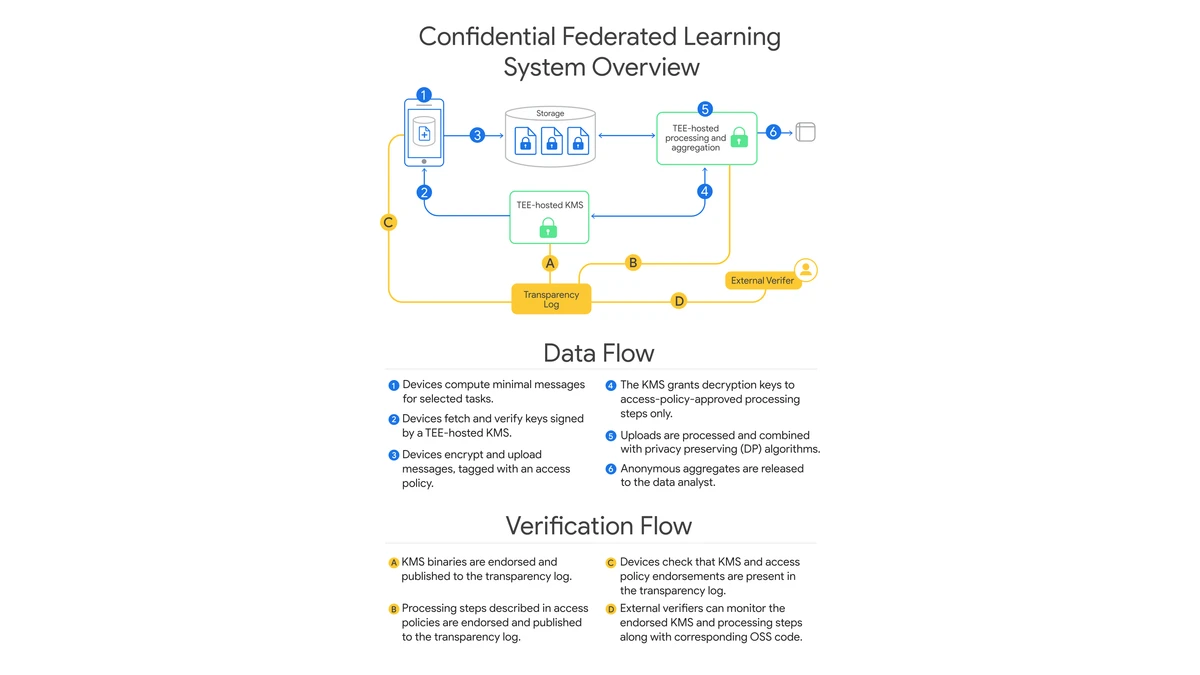
Google Research’s October 2 announcement describes a change in where federated learning happens. Phones encrypt selected training examples and upload them for processing inside trusted execution environments on servers. The system ties permission to particular workloads, then publishes the information needed to examine those workloads.
Google says Gboard has deployed the architecture for English and Japanese next-word prediction. It reports improved accuracy and faster training. The technical interest extends beyond a keyboard: moving computation can make larger workloads practical, provided the privacy controls follow the data all the way through processing and release.
The location of computation changes
Federated learning coordinates learning across data controlled by multiple clients. A familiar implementation performs substantial training work on participating devices, then combines updates. That arrangement constrains the server’s access, but also makes progress dependent on phones being available and able to compute.
Google’s new design moves client-gradient computation into protected server environments. This distinction matters when evaluating a privacy claim. Data minimization, confidentiality during processing, and the information revealed by a trained model are separate properties. Keeping computation on a phone is one way to limit exposure. Moving it requires another mechanism that governs what the server can actually read and do.
The practical trade is between two kinds of scarcity. A phone has a battery, a user, and intermittent availability. A server can schedule a larger pool of computing resources, but its operator must be prevented from turning training access into general access to personal examples. The new architecture addresses that second problem through a chain of cryptographic permissions and hardware-backed execution.
For background on the field, Qiang Yang and colleagues’ Federated Learning on Amazon I may earn a commission introduces distributed learning and privacy methods. The 2019 book provides foundations rather than documentation of Google’s newly announced system.
Permission follows the workload
In the announced system, each upload carries an access policy describing the computations allowed to process it. The data is encrypted locally. A key-management service releases decryption keys only to server workloads that match the policy and execute in approved trusted environments.
A trusted execution environment isolates a program and its internal state from the surrounding operator, within the hardware’s security assumptions. Remote attestation provides evidence of the software that is running. Together, isolation and attestation let a client distinguish a declared training workload from an ordinary server process asking for the same data.
This creates a useful separation of responsibilities. Storage can hold encrypted uploads without possessing unrestricted reading access. The key service can enforce permission without performing the model’s training itself. The training program can operate on examples while remaining constrained in what it releases. Each boundary addresses a different opportunity for exposure.
Consider the difference between a promise to delete data and a policy that limits which program receives the decryption key. The first depends primarily on subsequent operator behavior. The second makes the permitted computation part of the access decision. Both still require correct implementation, but they offer different forms of evidence to a person assessing the system.
An audit trail becomes part of training
Google publishes access policies to Rekor, a public transparency log. It also says the key-management and data-processing binaries can be reproduced from published source code. An external verifier can therefore examine the set of approved workloads and connect the declared code with the software admitted to protected execution.
The training architecture uses a coordinating root environment and multiple worker environments. Parallel tasks are expressed through Federated Language, an orchestration language derived from TensorFlow Federated. Encrypted recovery state supports restarting after failures without making private state available as an ordinary troubleshooting artifact.
Recovery is a significant detail. Production training rarely consists of one uninterrupted computation. Machines fail, jobs restart, and operators inspect logs. A privacy design has to cover those paths too. Otherwise, a carefully protected main process can be undermined by an exposed checkpoint or a diagnostic file containing examples.
Public logging also changes the accountability question. It gives observers an inventory of what processing was authorized. It does not automatically explain every program’s behavior to an ordinary phone user. Useful auditing still requires a comprehensible policy, inspectable code, and a way to identify which evidence applies to a particular workload.
Confidentiality and private outputs do different jobs
The announcement says workload operators see metrics and differentially private model weights. Protected execution limits visibility into processing. Differential privacy limits what released results can reveal about an individual’s contribution. These controls operate at different stages and should be evaluated separately.
For a developer, this means an encrypted upload is only the beginning of the analysis. The workload’s allowed inputs, retention period, output channels, and privacy parameters determine the resulting guarantee. A secure path into training does not, by itself, establish that every downstream use of the model preserves the same privacy property.
Google also allows proprietary model architecture and preprocessing information to be loaded at runtime, while requiring privacy-relevant logic to remain fixed in the published training program. That boundary is particularly consequential. Auditability depends on knowing which aspects of a workload can vary and which decisions remain governed by the inspectable program.
Gboard provides a concrete starting point
Collecting encrypted uploads before server training reduces dependence on the daily rhythm of device availability. Server-side parallelism can then accelerate computation and permit different participation schedules. Google attributes Gboard’s gains to these design changes, rather than simply describing a faster processor.
The announcement leaves important boundaries explicit. Trusted hardware has limitations, side-channel protections remain an area of research, and stronger proofs of software correctness are future work. Those details determine how broadly the stated guarantee can travel beyond the deployed keyboard models.
The useful advance is an architecture in which data access, computation, recovery, and output release can be examined as connected steps. For people evaluating private AI training, the central question becomes concrete: which program is authorized to see the data, what can leave that program, and what evidence lets someone outside the operator verify the answer?